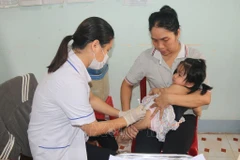
Health worker examines an HIV patient. (Photo: Vietnam+)
Vietnam has been striving for ‘90-90-90 target’ in fighting HIV as set in its national strategy for eliminating HIV in 2023. The triple 90 target seeks to have 90% of people with HIV being aware of their health condition, 90% people diagnosed as having HIV getting ARV treatment and 90% ARV-treated patients having a low viral load.
For better insight into the matter, VietnamPlus interviewed Mr. Vo Hai Son, Deputy Director of the Vietnam Administration for HIV/AIDS Control.
What is your assessment of HIV/AIDS situation in Vietnam?
Vo Hai Son: Vietnam currently has 230,344 people diagnosed with HIV, 175,400 of whom are receiving treatment with ARV, accounting for 76% of the total. Over 10,000 people are diagnosed with HIV on average each year.
Vietnam still faces major challenges in fighting HIV/AIDS, including discrimination against people with HIV. That especially hinders early detection and treatment. Ensuring continual ARV treatment among patients is also a big challenge in fulfilling the National Strategy on Eliminating HIV/AIDS.
 Vo Hai Son, Deputy Director of the Vietnam Administration for HIV/AIDS Control. (Photo: Vietnam+)
Vietnam is among few countries that have established the community advisory board (CAB) initiative. Could you please elaborate on the role of CABs in fighting HIV/AIDS?
Vo Hai Son: The Community advisory board (CAB) model is relatively new in Vietnam.
The CAB members are middle men who collect opinions of those under HIV/PrEP treatment, and then provide feedback to health facilities and treatment service providers to improve treatment quality.
Up to this point, six provinces implementing the Meeting Targets and Maintaining Epidemic Control (EPIC) Project has deployed CAB model. The CABs are now supporting 41 health facilities that treat HIV patients with ARV/PrEP and providing consultation and other HIV/AIDS-relevant services to over 10,000 clients, contributing to improving HIV treatment quality.
Does the Vietnam Administration for HIV/AIDS Control have any plans or strategies to sustain and expand CAB models in Vietnam?
Vo Hai Son: Studying the experiences of other countries and correlating to Vietnam’s situation, the Vietnam Administration for HIV/AIDS Control in October 2021 issued Decision 237 on instructing to implement CAB at health facilities. The decision enables all localities to deploy the model regardless of their situations.
In the two years since the instruction was given, coupled with assistance from the US-based President's Emergency Plan for AIDS Relief (PEPFAR), the model was used in six provinces and cities with 41 ARV-PrEP treatment facilities. Some 10,000 clients have received HIV/AIDS related services. Those results, though still humble, are encouraging as they have contributed to improving HIV treatment quality.
In the coming time, the model is expected to deploy at needy localities nationwide.
How has Vietnam applied PEPFAR’s strategies in managing CAB’s activities?
Vo Hai Son: With a strategy to control HIV/AIDS and eliminate the disease by 2030 and remain aware of community input, PEPFAR has proposed initiatives to fight HIV/AIDS, including CAB.
In order to promote effectiveness of the model, we look to consolidate policies and activities to fight against HIV/AIDS from the central to the local level. Community groups will receive more concrete guidelines to fight the disease in line with the Amended Law on Preventing and Fighting HIV/AIDS issued by the National Assembly in November 2020.
 People review instructions on preventing and fighting HIV/AIDS. (Photo: Vietnam+)
The Vietnam Administration for HIV/AIDS Control has been cooperating with PEPFAR to deploy social contracts with firms operating in healthcare sector. This is both an opportunity and a challenge for social organizations, requiring them to work in a more professional manner.
What has Vietnam done to achieve the target of eliminating HIV/AIDS by 2030?
Vo Hai Son: The Prime Minister on August 14, 2020 issued Decision 1246 on approving the National Strategy on Eliminating AIDS by 2030, which stipulates detailed goals, targets and 11 solutions to fulfill them.
Up to this point, we have implemented the solutions, such as building a legal framework, technical training, capacity building and resource mobilization.
Technical solutions focus on communication to raise awareness on HIV/AIDS and mitigate discrimination against the disease. Concrete measures to realize the 90-90-90 target and improve HIV treatment effectiveness have also been deployed.
We have also prompted prepping measures to protect the high-risk groups, such as treating at exposure with PrEP, and preventing virus transmission from mothers to the fetuses. If these activities are carried out nationwide, the target of eliminating AIDS by 2030 is feasible.
Thank you for providing the interview./.