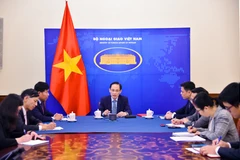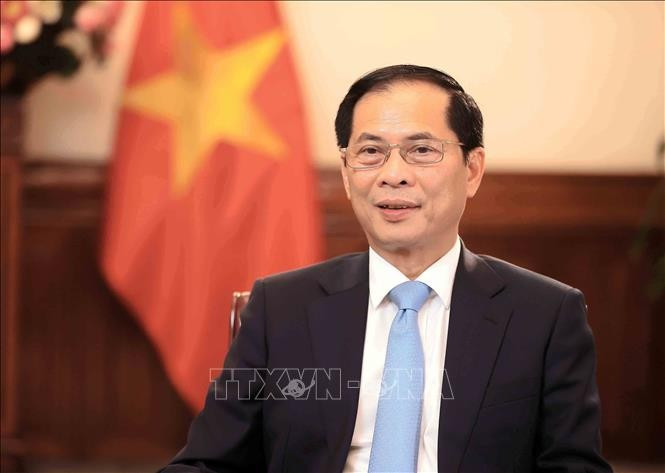
Hanoi (VNA) - Deputy Prime Minister and Minister of Foreign Affairs Bui Thanh Son has highlighted the prominent diplomatic achievements of Vietnam, the diplomatic service's contributions to the process of national development over the last eight decades, and its future development orientations.
In an interview granted to the press on the occasion of the 80th founding anniversary of the diplomatic sector (August 28, 1945 - 2025), Son said the country’s diplomatic service has played a vital role in the nation’s struggle for independence, resistance wars, and ongoing process of national construction and defence.
In its precarious early days, Vietnam’s diplomacy safeguarded revolutionary gains, preserved the young government, and won time to prepare for a protracted resistance war through landmark agreements, including the Preliminary Agreement on March 6, 1946, the Provisional Agreement on September 14, 1946, and tireless efforts at the Da Lat and Fontainebleau conferences, Son said.
During the fight against colonial and imperial forces, Vietnam’s diplomatic sector played a crucial role in supporting the resistance, breaking isolation, expanding relations, and securing international backing. It capitalised on military victories to bring nations to the negotiating table. The Geneva and Paris Agreements were not only landmark diplomatic achievements but also paved the way for the South’s liberation and national reunification, ending the country’s arduous 30-year war against foreign invaders.
Son also underlined the sector’s contributions to the post-war reconstruction period, stating that it led efforts to break isolation and sanctions, helping the country overcome socio-economic difficulties, normalise relations with China and the US, restore ties with Southeast Asian countries, and expand its global relations.
Following a policy of diversification and multilateralisation of relations, Vietnam now maintains diplomatic relations with 194 countries, has strategic or comprehensive partnerships with 38 nations, including all UN Security Council permanent members, G7 countries, and most G20 nations. Vietnam is also an active member of over 70 international organisations, he said.
Alongside defence and security, diplomacy has helped build a peaceful and friendly borderline, safeguard national sovereignty and territory, and create cooperation mechanisms for resolving border and territorial issues peacefully. The multilateral diplomacy contributed to transforming Vietnam from an isolated nation into an active and responsible member of the international community. Economic diplomacy and international integration have become key drivers of socio-economic development, mobilising external resources for development. The overseas Vietnamese affairs, cultural diplomacy, external information, and citizen protection continue to be implemented effectively and comprehensively.
Over its 80-year history, under the leadership of the Communist Party of Vietnam (CPV), diplomatic missions have overcome challenges, upheld proud traditions, served the nation and people, and contributed to the great achievements of the revolutionary cause, Son noted.
According to the official, the sector matured through 30 years of resistance, and grew stronger during 40 years of “Doi moi” (renewal), enduring the most challenging periods of Vietnam’s revolutionary history and leaving valuable lessons that remain relevant today, including prioritising national interests. It has combined domestic and external strengths, as well as national resolve with the spirit of the era, to create a formidable collective power and mobilise enormous material and moral support from the progressive international community.
These lessons helped shape the core values of a diplomacy deeply rooted in Vietnam’s national identity and characters. It is a diplomacy dedicated to national interests and serving the people, resilient and firm yet flexible and tactful, reflecting the courage, wisdom, and spirit of the Vietnamese people forged over millennia. At the same time, Vietnam’s diplomacy harmoniously blends national and international elements, embracing external achievements while contributing responsibly to global politics and economy, and human civilisation.
After nearly 40 years of “Doi moi”, Vietnam has achieved great and historic accomplishments, Son stressed, adding that with the country’s new position and strength, the sector is expected to enhance its role and contribute to the nation’s development in the new era.
First, the sector must play a pioneering and crucial role in creating and strengthening a favourable diplomatic environment, pursuing the three goals of security, development, and enhancing the country’s position, focusing on deepening relations with other nations effectively and sustainably, and across the fields of politics, defence, security, economy, science - technology, education and training, culture, and people-to-people exchanges.
Second, through economic and science-technology diplomacy, the sector plays a pioneering role in seizing opportunities, overcoming challenges, and creating new drivers for national development by effectively combining domestic and external strengths.
Third, Vietnam should enhance its contributions to global peace, cooperation, development, and progress. The country’s new position and strength run deeper, enabling more responsible participation in multilateral forums addressing international issues, contributing to peace, stability, cooperation, and development in the region and the world.
Fourth, the sector also seeks to uphold the nation’s “soft power,” thus enhancing Vietnam’s image and position in the international arena. The country’s soft power not only supports socio-economic development but also strengthens Vietnam’s connection with the world.
Fifth, attention has been paid to building a comprehensive, modern, and professional Vietnamese diplomacy that meets the requirements of the new era, matches regional standards, and reaches international stature.
Son emphasised the role of diplomacy in implementing the four “pillar” resolutions of the Politburo, covering institutions, science and technology, private economic development, and international integration, highlighting Resolution 59-NQ/TW as a turning point in the country’s approach to international integration. He noted that international integration is defined both as a “crucial and ongoing” task and as an “important driver” guiding Vietnam into the new era.
Today, international integration goes beyond positioning Vietnam as a “latecomer” or merely a participant; it establishes the country’s role in “building,” “shaping,” and “leading” cooperation frameworks that align with its new capacities and conditions, Son said.
The official also highlighted Vietnam’s achievements in international economic integration and the role of economic diplomacy in contributing to the nation's development goals.
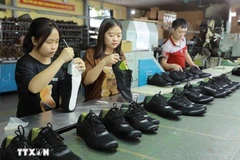
Vietnam has established economic and trade relations with over 230 countries and territories, signed and implemented 17 free trade agreements (FTAs), including several new-generation deals, and promoted negotiations with other partners. Economic diplomacy has been crucial in Vietnam's emergence as one of the world's top 32 countries by GDP, and among the top 20 for trade volume and foreign investment attraction.
The active implementation of the Secretariat’s Directive 15 on economic diplomacy has helped position Vietnam as an important player in regional and global markets, expand cooperation in new sectors, participate more deeply in supply chains, and improve its standing in the global value chain, Son noted.
Aligned with the country’s development goals, including double-digit growth and the two centennial objectives, economic diplomacy will focus on maximising benefits from existing trade and investment agreements, mobilising new investment and financial sources, particularly from major enterprises and funds, and translating upgraded frameworks into practical and effective economic cooperation programmes and projects.
Attention will be paid to actively promoting growth by revitalising traditional drivers such as investment, exports, and consumption, while strongly advancing new growth drivers, including science - technology, digital transformation, green growth, circular economy, and knowledge-based economy; seizing opportunities from emerging trends; establishing deep cooperation with global innovation hubs, including countries and enterprises in groundbreaking fields like high technology, semiconductors, AI, and quantum technology, he said.
The sector will continue assisting ministries, localities, and businesses to eliminate obstacles, create leverage, build connections, and attract new projects and collaboration programmes, Son added.
According to the official, Vietnam’s success stories have inspired the international community. Today, Vietnam is highly regarded as a rapidly rising nation, a successful model of socio-economic development, with an increasingly influential role and voice in the international arena.
Son quoted UN Secretary-General António Guterres, who has repeatedly described Vietnam as a “model of peace and sustainable development;” and ASEAN Secretary-General Kao Kim Hourn, as saying that Vietnam is an important member that makes key contributions to strengthening intra-ASEAN unity, and enhancing the bloc’s role and capacity in dialogue and cooperation with global partners./.