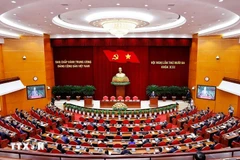
Hanoi (VNA) – The Communist Party of Vietnam has launched a nationwide consultation drive, soliciting input from citizens, officials, and Party members on the draft political report to be submitted to its 14th National Congress next year.
Harnessing collective wisdom
Assoc. Prof. Dr. Nguyen Thi Ngoc Hoa, head of the Political Science Faculty at the Academy of Journalism and Communication, said the draft political report has been meticulously prepared, giving an in-depth review of 40 years of Doi Moi (renewal). It evaluates the achievements and shortcomings of the Party's 13th term, draws key lessons, and make forecasts.
Hoa expected that the consultation process will attract frank and constructive feedback, especially bold ideas, to propel national progress.
According to her, this draft introduces many innovations, most notably a deeper articulation of the socialist rule-of-law state model. It outlines a strong political commitment to ensure effective control on the exercise of state power, accelerate judicial and administrative reforms, uphold the Constitution and laws, and create mechanisms for citizens to truly engage in supervising the exercise of power.
“This is the key to upholding democracy while maintaining discipline, preventing corruption and misconduct, and fostering development”, Hoa said.
She proposed that the report include a strategic breakthrough: building and fine-tuning institutional frameworks for development, with a focus on those for efficient allocation and use of resources.
Hoa called for “breakthrough mechanisms” to unlock all development resources, particularly land, human capital and finance. The institutional framework, she added, must guarantee a transparent and fair competition environment and protect cadres who dare to reform and take responsibility for the common good.
The Party’s strong commitment to public engagement
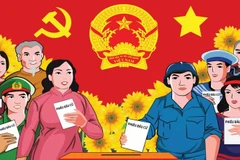
Public disclosure of feedback and responses reinforces accountability and helps the Party identify breakthrough solutions while avoiding the spread of resources too thinly. It also embodies the 14th National Party Congress’s motto: “Solidarity – Democracy – Discipline – Breakthrough – Development”, underscoring the Party’s strong commitment to close ties with the people and the goal of building a strong and prosperous Vietnam.
The draft reflects renewed thinking and a shift in development philosophy, from “creativity” to “breakthrough”, signalling the determination to comprehensively restructure Vietnam’s mechanisms, society, and economy for a new development phase.
Three reports covering the 40-year Doi Moi review, orientations to 2030, and vision to 2045 have been merged into a single document centred on three pillars: human development, innovation, and Party building. The report targets average annual GDP growth of 10% for 2026–2030, a complete transition toward a knowledge- and technology-based economy, and a stronger private sector role alongside fortified key state-owned enterprises.
For the first time, consultations have blended online and offline channels, with all submissions encrypted and auto-classified for review.
According to Diep Nang Binh, head of the Tinh Thong Law Office, the most notable feature of the draft is its emphasis on “institutional perfection” as the central pillar. It considers institutional shortcomings as the "bottleneck of all bottlenecks" that resulted in slow and uncoordinated policy responses.

It also highlights deeper decentralisation and delegation of authority, coupled with independent supervision, accountability, and a streamlined two-tier local administration model after 2025. This is an important change that will enhance localities' autonomy, reduce policy lags, and create a more flexible development space, according to the lawyer.
“Pinpointing science – technology, innovation, and digital transformation as the main breakthrough is particularly significant,” Binh said. “The draft envisions a flexible legal environment that tolerates risk and allows pilot policies in emerging areas such as AI, digital economy, green and circular economies, plus overhauls in human capital and strategic infrastructure policies, with priority to multimodal transport, renewable energy, and digital infrastructure.”
To deliver strategic leaps, Binh suggested three key groups of solutions. The first is strengthening institutional accountability and power control, and strongly shifting from pre-approval to post-audit mechanisms. Performance indicators, such as public investment disbursement rates, citizen satisfaction levels and the Provincial Governance and Public Administration Performance Index (PAPI) scores, should be tied to the accountability of top officials.
Second, legal frameworks for new growth drivers and green transition should be established, including policy “sandbox” decrees for experimental reforms. Simultaneously, refining laws on land, intellectual property and capital markets to unlock private resources is also essential.
Third, social and digital citizenship mechanisms are also critical, along with legislating university autonomy, earmarking at least 1% of the regular spending budget for high-quality workforce training, and enacting a national data governance law to ensure cybersecurity and build digital trust – the foundation for e-government and digital economy.
Binh also suggested the creation of a policy appraisal institute under the National Assembly and piloting full-time People’s Council deputies in major cities to enhance independent feedback and policy evaluation. He proposed that the final report include an annexe with a “timeline – task – metric” framework to monitor progress through 2030, thus ensuring feasibility and political accountability./.