From community recycling to national movement: Vietnam turns tide on plastic waste

The fight against plastic pollution could not succeed through isolated efforts, but it must be a collective endeavour involving the entire political system, businesses, citizens, and the international community, said Minister of Agriculture and Environment Do Duc Duy.

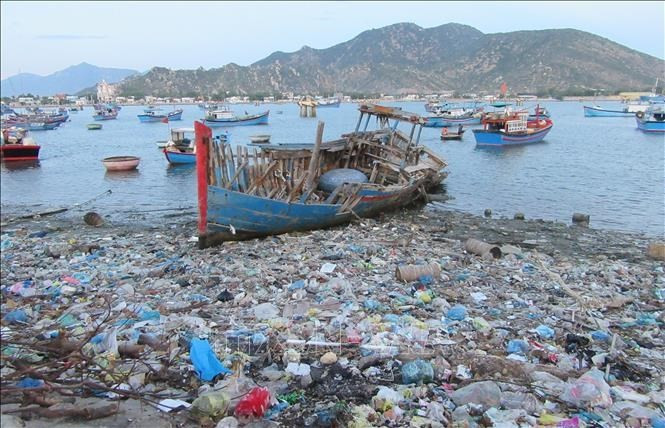
Over 11 million tonnes of plastic end up in the oceans each year, threatening biodiversity, food chain, and livelihoods of millions of people. (Photo: VNA)

Hanoi (VNA) – As the World Environment Day (June 5) spotlights the prevention of plastic pollution towards green lifestyle, circular economy, and sustainable future, Vietnamese communities are proving that meaningful change begins with individual action and collective determination.

In the northern coastal province of Quang Ninh, home to the UNESCO-recognised Ha Long Bay, a transformative revolution is unfolding as the Green Life Ha Long Cooperative developed into a network connecting farmers, schools, markets, and businesses. They adopt a three-step process that turns discarded materials like plastic bags, fabric scraps, and PVC banners to useful products such as bags, carpets, name tags and hair ties.

Director of the cooperative Tran Thi Huong said each product represents a rebirth, beginning with collecting plastic bottles, gathering fabric scraps, and composting organic waste. What appeared to be simple steps demanded tremendous efforts, meticulous attention, and unwavering dedication.

She shared that her vision goes far beyond production and it is about shifting mindset, transforming waste into resources, consumption habits into environmental actions, and each individual into part of the solution.

Green Life is envisaged to turn the model into an eco-tourism destination that includes recycling activities and green living practices. To deliver on the goal, Huong said, the cooperative needs support from competent authorities regarding the removal of barriers in land allocation, permits for tourists' overnight stays, and integration with existing tours.

Currently, it is operating an experience area where tourists could engage in classifying and recycling waste as well as crafting new products from discarded materials. The site draws up to 700 visitors a day, most of whom are international tourists.

According to Chief Executive Officer of the World Wide Fund for Nature (WWF) Vietnam Van Ngoc Thinh, over 11 million tonnes of plastic end up in the ocean each year, threatening biodiversity, food chain, and livelihoods of millions of people.

He called for responsible consumption, appropriate waste collection, sorting and recycling, as well as investment in education and communications, elaborating that raising public awareness is the key to behaviour change.

Quang Ninh province, boasting strong sea-based tourism and economy potential, has carried out multiple measures to change the behaviour of local residents and tourists regarding single-use plastics reduction.

In Ha Long Bay, waste collection, particularly floating foam buoys, has been maintained. Head of the Ha Long Bay Management Board Vu Kien Cuong said dedicated forces are regularly deployed to collect, transport, and handle waste while monitoring seawater environmental quality and promptly addressing pollution factors.

At the same time, the province has paid due attention to environmental protection in aquaculture—an important economic sector with more than 42,000 hectares of farming, including 10,200 hectares of mariculture.

The province has tackled a major pollution source by replacing cheap but environmentally destructive foam buoys with durable HDPE plastic alternatives. Since 2020, aquaculture operations have been transitioning to the long-lasting material that withstands storms without breaking apart and contaminating the marine ecosystem.

Minister of Agriculture and Environment Do Duc Duy said that the fight against plastic pollution could not succeed through isolated efforts. It must be a collective endeavour involving the entire political system, businesses, citizens, and the international community.

Duy called for beginning with the simplest changes, shifting consumer habits and adopting waste sorting, towards a country without plastic waste for future generations./.

VNA

See more

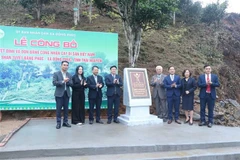
Official heritage plaque i sinstalled on the 12 recognised Shan Tuyet tea trees in Dong Phuc commune. (Photo: VNA)

Thai Nguyen: 12 ancient Shan Tuyet tea trees win national heritage status

The recognition honours the biological, cultural and historical values of these centuries-old Shan Tuyet tea trees – natural treasures deeply woven into the livelihoods, traditions and identity of local ethnic communities. The title affirms the community’s commitment to preserving and promoting the value of this iconic local tea variety.

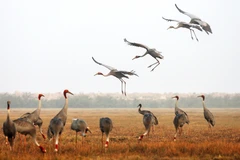
Sarus cranes at Tram Chim National Park (Photo: VNA)

Return of sarus cranes: Hope takes wing in Dong Thap wetland

Beneath the wide Mekong Delta sky, Tram Chim National Park is racing against time, pouring heart and science into a decade-long (2022–2032) plan to rescue the Eastern sarus crane – an elegant, scarlet-headed bird listed as endangered on the International Union for the Conservation of Nature (IUCN) Red List and a living emblem of both the park and all of Dong Thap province

French Ambassador Olivier Brochet speaks at the press conference in Hanoi on December 11 to mark the 10th anniversary of the Paris Agreement on climate change and highlighting the COP30 outcomes. (Photo: VNA)

International community ready to support Vietnam in energy transition, climate response

In a video message to the press conference, UN Resident Coordinator in Vietnam Pauline Tamesis said the UN is ready to support Vietnam in building a pipeline of projects capable of absorbing financing mobilised under the Political Declaration on establishing the Just Energy Transition Partnership (JETP), as well as from global climate finance sources, including the Green Climate Fund and the Loss and Damage Fund.

Forest rangers in Son La province apply technological devices and software to forest management, monitoring, and protection. (Photo: nhandan.vn)

Digital technology application enhances forest management, protection

With a total forest area of over 14 million hectares, including more than 10 million hectares of natural forests, forests exist in all 34 provinces and cities across the country. Given the large area and limited workforce, applying digital solutions in forest management and protection has become a top priority for the forestry sector.

Sunda pangolins (Manis javanica), also known as the Javan pangolin, are listed in Group IB – critically endangered and strictly protected from all commercial exploitation (Photo: VNA)

Quang Ngai releases rare pangolin back into nature

Initial verification showed that the animal weighed 3.7kg and measured over 60cm. It was identified as a Sunda pangolin (Manis javanica), also known as the Javan pangolin, listed in Group IB – critically endangered and strictly protected from all commercial exploitation.

Residents of Tuyen Quang province take part in the One Billion Trees Programme. (Photo: VNA)

Tree-planting programme exceeds one-billion-tree goal

The total comprises 573.9 million scattered trees and 865.2 million trees grown in concentrated plantations, equivalent to 429,125 hectares of forest. Provinces posting the strongest results include Phu Tho with 177.9 million trees, Lao Cai with 108.8 million, and An Giang with 98.5 million.

Construction activity is one of the causes of air pollution in Hanoi. (Photo: VNA)

Hanoi takes urgent measures to curb air pollution

The city requires the enhanced application of advanced technologies and remote monitoring systems, including satellite remote sensing, drones, and AI-integrated traffic cameras, to monitor, detect, and strictly address the illegal burning of garbage, straw, and agricultural by-products.