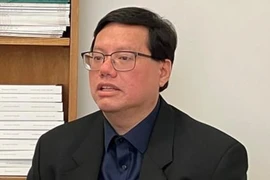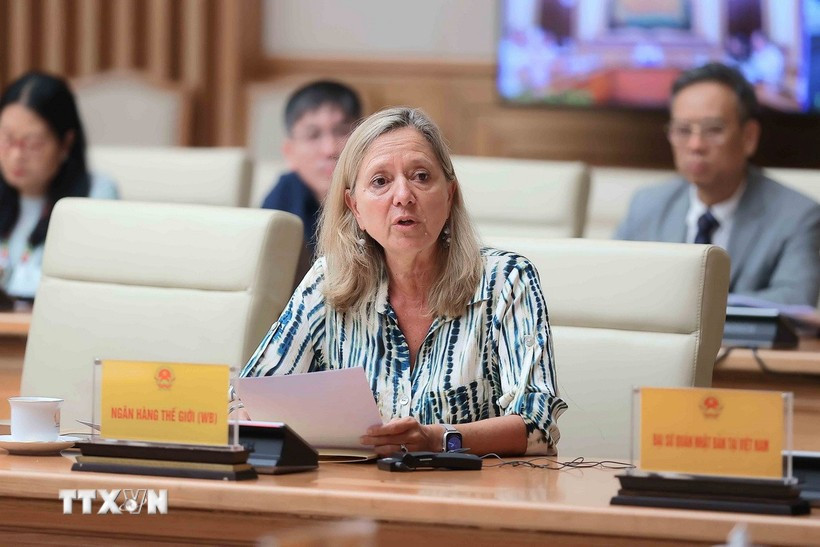
Hanoi (VNA) – FTSE Russell’s upgrade of Vietnam from frontier to secondary emerging market status signals growing confidence from international investors and recognises Vietnam's importance as an investment destination, according to Mariam J. Sherman, World Bank Division Director for Vietnam, Cambodia, and Laos.
FTSE Russell on October 8 (Hanoi time) announced that Vietnam will be reclassified from frontier to secondary emerging market status. The upgrade is expected to take effect on September 21, 2026, subject to an interim assessment in March 2026 to confirm Vietnam’s progress in improving market access through global brokers.
In an interview with the Vietnam News Agency, Sherman discussed the impacts of the FTSE Russell upgrade and outlined the path ahead.
Reporter: FTSE Russell recently upgraded Vietnam’s stock market to Emerging Market. What does this mean for Vietnam’s capital markets and broader economy?
Mariam J. Sherman: This upgrade is an important milestone, reflecting many years of Vietnam’s sustained reforms. I would like to offer my warm congratulations to the Government of Vietnam, especially the Ministry of Finance, the State Securities Commission, the Stock Exchanges, and the Security Depository and Clearing Corporation, and all market participants for this achievement.
The upgrade signals growing confidence from international investors and recognises Vietnam's importance as an investment destination. It underscores the considerable progress that Vietnam has made in modernising its capital markets: from strengthening the securities law to launching a new trading system and preparing more advanced market infrastructure of clearing and settlement.
Based on the World Bank Group's conservative estimates, the total portfolio flows associated with emerging-market status and the inclusion of Vietnamese equities in the FTSE Russell Emerging Markets Index could be in the range of 3–5 billion USD in the next couple of years.
Reporter: How should Vietnam take advantage of the increased global interest in Vietnamese assets resulting from this development?
Mariam J. Sherman: This is a major milestone, but it is only the beginning. The next step is Vietnam's full inclusion in the FTSE-Russell Emerging Markets Index in September 2026 so passive funds can flow in. Getting there will require enabling global brokers to fully participate in the market.
We are working closely with the State Securities Commission, investors, and market participants to help make that possible. Beyond the FTSE-Russell, which accounts for roughly 20% of the total global index market, the next big objective is recognition by MSCI, the largest global index provider. Achieving that would be transformative, potentially bringing three to four times more capital inflows than the FTSE upgrade.
To reach this stage, Vietnam needs to continue reforms, particularly: easing foreign ownership limits, implementing the new clearing and settlement system, and strengthening foreign exchange management.
Reporter: In a recent interview with us, Minister of Finance Nguyen Van Thang acknowledged the World Bank’s support in reaching this milestone. Can you elaborate on how the World Bank contributed?
Mariam J. Sherman: Capital markets development is part of a broader growth agenda in Vietnam that also includes building better infrastructure, fostering innovation, and supporting private sector-led development. As the Minister noted, this has been a journey, and the World Bank Group has been a very close partner throughout.
We work through the Joint Capital Markets Programme (J‑CAP), which brings together the World Bank Group’s strengths—global expertise, policy advice, and financing—to support Vietnam as it modernises its capital markets. Over the past decade, we have worked alongside the Vietnamese authorities as they strengthened market institutions. Since FTSE Russell placed Vietnam on its Watch List in 2018, the World Bank Group’s J‑CAP team, funded by Australia’s Department of Foreign Affairs and Trade and Switzerland’s State Secretariat for Economic Affairs, has provided policy advice and recommendations that contributed directly to tangible reforms.
For this market upgrade specifically, we supported the implementation of key reforms, including eliminating the pre‑funding requirement for foreign institutional investors, simplifying account‑opening procedures, enhancing disclosure practices (including in English), and easing restrictions related to foreign ownership limits.
Reporter: How do you view the prospects for Vietnam’s capital market development in the coming period?
Mariam J. Sherman: Vietnam is on the right track: vibrant capital markets will be central to mobilising domestic and international resources sufficient for Viet Nam to achieve its ambition of becoming a high‑income economy by 2045.
There is still more to do as Vietnam deepens its capital markets and opens further to foreign investors such as improving the legal framework, strengthening corporate governance, and implementing the roadmap for information disclosures— factors increasingly emphasised by international investment funds. These reforms will help the market operate more transparently, efficiently, and in line with international best practice, thereby reinforcing global investor confidence.
The World Bank Group together with partners will continue to draw on global expertise and financing to support Vietnam on this journey.
Reporter: Thank you so much!
VNA