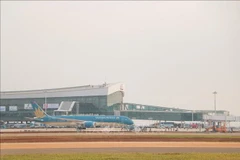
A bird's eye view of Hanoi (Photo: VNA)
 The point was highlighted in Plan 257/KH-UBND on strengtheningexports of the capital city in 2024 issued in late October.
Accordingly, the capital city aims for exports in 2024 to grow by5% over 2023.
In the plan, the city pointed out challenges for exports fromrising global uncertainties.
“The economic recession risk together with high inflation pressureare causing consumer demand to decline sharply around the world, includingEurope and America which are major trade partners of Vietnam,” the plan said.
Energy and food crises as well as disruptions in supply chains andrising material prices were still ongoing. Besides, green economy developmentwas bringing both opportunities and challenges to Vietnam’s exports asdeveloped economies may erect technical barriers.
However, addressing advantages from Vietnam’s stable macro-economyand the Government’s firm solutions to promote production and business, Hanoisaid it would focus on devising measures to enhance competitiveness of localenterprises and producers, to be able to best adapt to the new circumstances.
Under the plan, the capital city would strengthen administrativereforms with the focus on promoting the application of information andtechnology in processing administrative procedures, including tax, customs andcertification of origin, to facilitate exports.
In addition, mechanisms and policies would be raised to promoteproduction and exports, especially credit policies, together with solutions toimprove the quality of human resources meeting demand of enterprises.
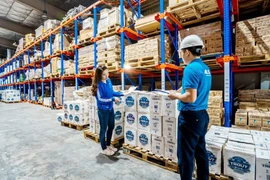
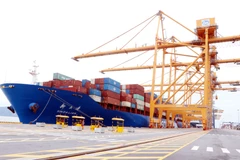
The city would increase the investment attraction ininfrastructure and logistics services to facilitate exports, and improve theefficiency of trade promotion programmes.
A recent study on promoting goods export of enterprises in Hanoiby Bui Thi Hoang Lan from the National Economics University suggested thecapital city restructure the industrial sector in association with digitaltransformation to create a new driver for breakthrough export growth.
The capital city should hasten the transition of export goodsstructure towards increasing added value and quality and establish valuechains.
Pointing out that Hanoi lacked foreign capital influx, which waslarge enough to create breakthroughs to production and export, Lan said thatthe capital city needed to raise policies to attract more foreign capital.
Besides, improving the competitiveness of enterprises andproducers in the city played a very important role in expanding exports. Thefocus would be on implementing regular training courses to enhance knowledgeand skills in product design, brand building, international integration,technical barriers in international trade, new policies, and market updates.
Lan also said that it was important to develop centres of rawmaterials for the production of export goods, and improve infrastructure ofindustrial parks to attract more investments in production.
Addressing problems from poor infrastructure, which caused risinglogistics costs and undermined the competitiveness of enterprises, Lansuggested Hanoi increase the attraction of investment in logisticsinfrastructure with the priorities in the systems to connect with otherprovinces in the Northern key economic region.
Incentives in land policies should be given to the development oflogistics centres towards the formation of a logistics market, which would helpincrease budget revenue, reduce inner-city traffic congestion and removebarriers to goods circulation and exports.
She also proposed policies be raised to attract investment in thedevelopment of large-scale “logistics villages” – a completely new businessmodel to facilitate exports.
The latest updates of the municipal Department of Statisticsshowed that the city reported a trade value of more than 5 billion USD in October,representing a rise of 2.1% against the previous month and 10.1% against thesame period last year.
Of the figure, export revenue was estimated at 1.45 billion USD, ayear-on-year increase of 7.6%.
For January – October, the city’s total export value reached 13.8billion USD, a slight drop of 1.4% against the same period of 2022 on fallingglobal consumption demand.
Hanoi reported a total export value of 17.1 billion USD in 2022, ayear-on-year increase of 10.6% exceeding the target of 5%, ranking the capitalcity 8th out of 63 provinces and cities in terms of export revenues.
The export value of the domestic economic sector was 9.181 billionUSD, higher than the export value of the foreign–invested sector which was at 7.9billion USD. This was a spotlight of Hanoi’s export in the context that thecountry’s export remained dependent of foreign–invested enterprises.
Major export products of Hanoi included garments, computers andelectronic components, machinery and components, timber and wooden products,and agricultural products.
In the 2017-2023 period, the city’s export revenue expanded onaverage 8.2% per year, except for 2020, which saw a drop of 3.4% due to theimpact of the COVID-19 pandemic.
According to Hanoi Statistics Department, there were more than2,500 enterprises in the capital city involved in exporting in 2022./.
VNA