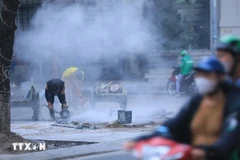
Hanoi (VNA) – Hanoi authorities are under significant pressure to improve air quality, particularly as the city rotates in and out of the top global ranking for air pollution levels, depending on routine measurements of the local environment.
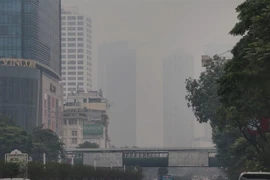
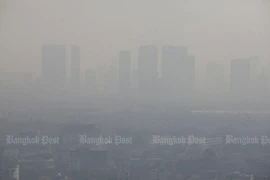
In early January 2025, the air quality index (AQI) in Hanoi indicated severe air pollution, consistently reaching harmful levels, with peaks exceeding 400.
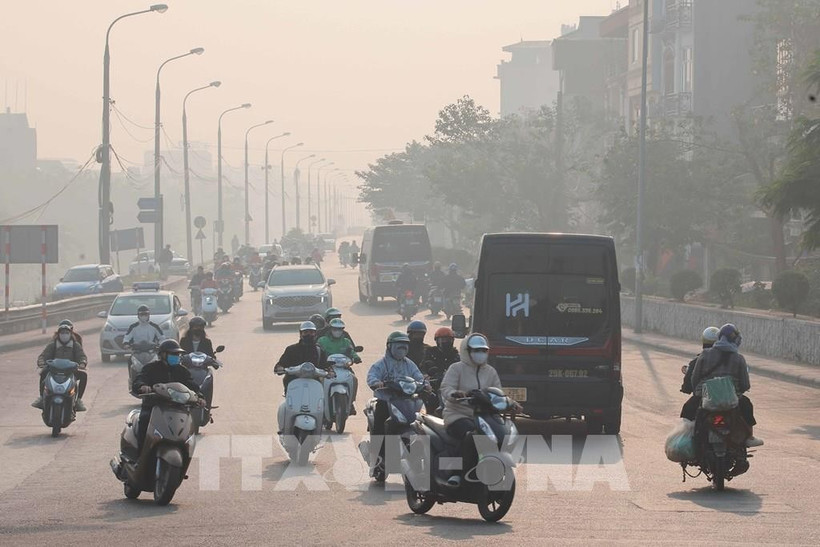
The dense dust fog not only hampers traffic but also exacerbates health issues for residents.On January 7, at about 8 am, air quality monitoring applications ranked Hanoi as the most polluted city in the world, with an AQI of 272, indicating a hazasdous level for human health.
In middle of this month, the AQI in West Lake area topped the pollution charts, with specific readings like To Ngoc Van at 416, Ciputra at 408, Quang Khanh at 372, and Quang Ba at 320.
These are all pollution levels classified as "maroon," which means hazardous to human health. Other areas reported purple AQI levels – very unhealth level - such as Tu Hoa (Tay Ho district) at 256, Le Duan (Hoan Kiem district) at 256, Lo Duc (Hai Ba Trung district) at 270, and Tran Hung Dao (Hoan Kiem district) at 233.
According to data from VN AIR of the Ministry of Natural Resources and Environment and moitruongthudo.vn of the Hanoi Department of Natural Resources and Environment, air quality in the capital frequently falls into unhealthy and harmful to sensitive residents, especially from September to March of 2023.
Statistics indicated that during peak pollution periods, the AQI often fluctuates around 200, far exceeding safe levels and posing serious health risks.
The daily and annual average concentrations of particulate matter (PM) 10 and PM2.5 dust in Hanoi exceed the recommended levels by the World Health Organisation.
Local pollution levels of NO2 and O3 have also been recorded.
Fine dust pollution is noted in almost all districts, especially in densely populated urban areas with heavy traffic.Health experts warned that air pollution in Hanoi is not only a short-term threat but also poses long-term risks to public health.
Prolonged exposure to PM2.5 fine dust can lead to severe health issues such as pneumonia, bronchitis, asthma, and lung cancer. Additionally, fine dust can impair cardiovascular function, increasing the risk of stroke and vascular diseases.
Moreover, air pollution affects labour productivity and the quality of life of residents. Outdoor activities are restricted, and traffic is challenging due to reduced visibility.
Furthermore, respiratory-related illnesses increase healthcare costs, creating a financial burden for individuals and society.
Challenges in urbanisation
Hanoi is one of the most populous and rapidly developing cities in Vietnam, with over 8 million residents and millions of vehicles on the road daily.
Among these, transport is the largest source of fine dust emissions, accounting for 50-70% of total PM2.5 emissions. Old vehicles that do not meet emission standards are still commonly used, increasing toxic emissions.
Additionally, the city faces emissions from more than 17 industrial zones, around 1,300 craft villages, and spontaneous waste burning in suburban areas.
The consumption of fossil fuels, such as gasoline and coal, along with the use of traditional coal stoves and burning agricultural by-products, also contributes to the rising levels of air pollution.
Nguyen Minh Tan, Deputy Director of the Hanoi Department of Natural Resources and Environment, said that the lack of coordinated urban planning and insufficient environmental protection measures during infrastructure development, as well as uncontrolled construction activities, are significant sources of fine dust that severely affect air quality in urban areas.
Although Hanoi has begun to inventory emission sources, the slow implementation of solutions has resulted in persistent high pollution levels.
Key solutions
Integrated solutions, such as controlling emission sources, developing green transport, establishing low-emission zones, and raising community awareness, are crucial steps to improve air quality, according to experts.
According to the Air Quality Management Plan until 2030, Hanoi aims to reduce total PM2.5 emissions by 20% compared to 2019, equivalent to a reduction of 6,200 tonnes of fine dust. One of the key solutions is to implement an automatic monitoring system to track and supervise air quality.
Data from this system will help authorities identify the root causes of pollution and develop effective mitigation measures.
Nguyen Trong Dong, Vice Chairman of the Hanoi People's Committee, said that the city requires a complete resolution of straw and waste burning in suburban areas, while also enhancing traffic management by rerouting and regulating traffic at congestion points.
The implementation of low-emission zones (LEZ) starting in 2025 is considered a breakthrough step to limit the circulation of non-compliant vehicles in urban areas.
Furthermore, the city is researching and seeking input to refine policies supporting clean energy buses, expanding the elevated railway system, and developing modern public transport projects.Developing green transport is a long-term solution to address air pollution, Dong emphasised.
The city's goal is to limit motorcycle usage in urban districts by 2030 and eventually eliminate old motorcycles that do not meet emission standards.
The use of fossil fuel vehicles, especially diesel cars, will also be restricted in central areas.Additionally, Hanoi is calling for investment in public transport projects such as BRT systems, monorails, and urban railways. Developing public transport will not only reduce emissions but also significantly improve air quality, creating a sustainable transport ecosystem./.