HCM City to convert 400,000 ride-hailing motorcycles to electric by 2029

HCM City currently has 600 public charging points, meeting less than 10% of the projected demand of 350,000-400,000 electric two-wheel vehicles in the future. Therefore, it is necessary to build 3,000 public charging and battery swap stations before December 2028.

xe-om-cong-nghe.jpg
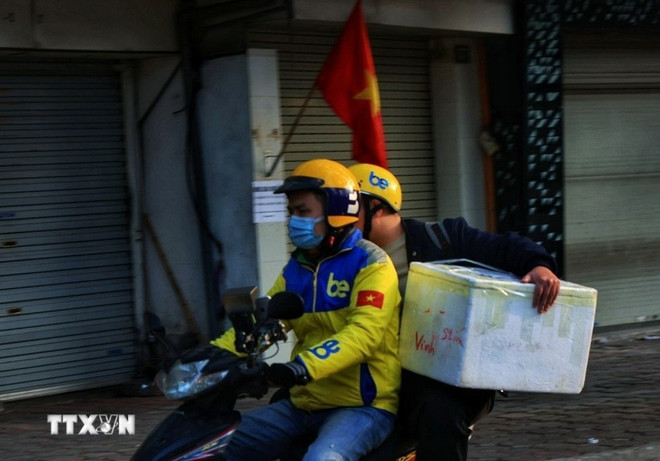
According to a survey conducted by the institute in 2023, each e-hailing driver in the city travels an average of 80-120 kilometres daily, three to four times more than ordinary citizens. (Illustrative photo: VNA)

HCM City (VNA) - Ho Chi Minh City has set a target to transition some 400,000 ride-hailing gasoline motorcycles to electric vehicles by the end of 2029 under a freshly completed draft project.

The proposal, penned by the Department of Construction in collaboration with the Ho Chi Minh City Institute for Development Studies (HIDS), will be submitted to the municipal People’s Committee this week. It aims to achieve a 100% reduction in air pollution and greenhouse gas emissions from this vehicle category.

According to a survey conducted by the institute in 2023, each e-hailing driver in the city travels an average of 80-120 kilometres daily, three to four times more than ordinary citizens. This means converting a driver's motorcycle to electric one has a significant impact on emission reduction compared to personal two-wheel vehicles.

Le Thanh Hai, Director of the HIDS’s Centre for Economic Application Consulting, said that converting this group to electric vehicles creates a ripple effect throughout society while helping drivers achieve substantial savings through reduced fuel and maintenance costs.

The project outlines specific phases with quantitative targets tied to concrete timelines, creating a foundation for measuring and evaluating progress and effectiveness during implementation. It aims for 30% conversion by the end of 2026, or some 120,000 vehicles; 80% by the end of 2027, or 320,000 vehicles; and 100% by the end of 2029, equivalent to around 400,000 vehicles. Following its merger with Binh Duong and Ba Ria-Vung Tau provinces, the city now has some 11 million vehicles, including 1.5 million cars.

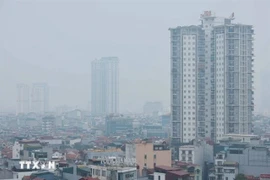
The HIDS said that transport activities are considered one of the primary emission sources causing air pollution in the city. Alarmingly, urbanisation pressure has caused emission trends to continue rising in recent years, particularly regarding dust and noise pollution.

Without early intervention, total transport emissions could increase 2.6-fold to top 44 million tonnes of pollutants annually by 2030, experts from the Department of Agriculture and Environment warned, stressing the need for sustainable transport solutions such as transitioning to electric vehicles to improve environmental quality and protect public health.

Hai said that Ho Chi Minh City should enact priority policies, including financial support for drivers through VAT exemptions, registration fee waivers, and licence plate registration fee eliminations, along with easier access to low-interest loans.

The plan also encompasses preferential policies for electric vehicle manufacturers and energy infrastructure development, together with incentives to encourage investors to build charging stations and battery swap stations, he stated.

Experts also recommended policies for domestic electric vehicle and component manufacturers to receive import tax incentives for components, land use benefits, and development credit access. Besides, the city should establish a roadmap to ban fossil fuel two-wheel vehicles from passenger and freight transport services, ensuring drivers’ financial rights while promoting charging infrastructure investment.

Specifically, preferential policies will be implemented and the issuance of new operating licences to gasoline motorcycle drivers seeking to enter the ride-hailing market will stop from early 2026. From 2027, gasoline motorcycles will be restricted during peak hours in low-emission zones. From 2028, emission control policies will be tightened, and by the end of 2029, gasoline motorcycles will be completely banned from providing services on ride-hailing technology platforms.

The city currently has 600 public charging points, meeting less than 10% of the projected demand of 350,000-400,000 electric two-wheel vehicles in the future. Therefore, it is necessary to build 3,000 public charging and battery swap stations before December 2028./.
VNA

See more

Official heritage plaque i sinstalled on the 12 recognised Shan Tuyet tea trees in Dong Phuc commune. (Photo: VNA)

Thai Nguyen: 12 ancient Shan Tuyet tea trees win national heritage status

The recognition honours the biological, cultural and historical values of these centuries-old Shan Tuyet tea trees – natural treasures deeply woven into the livelihoods, traditions and identity of local ethnic communities. The title affirms the community’s commitment to preserving and promoting the value of this iconic local tea variety.

Sarus cranes at Tram Chim National Park (Photo: VNA)

Return of sarus cranes: Hope takes wing in Dong Thap wetland

Beneath the wide Mekong Delta sky, Tram Chim National Park is racing against time, pouring heart and science into a decade-long (2022–2032) plan to rescue the Eastern sarus crane – an elegant, scarlet-headed bird listed as endangered on the International Union for the Conservation of Nature (IUCN) Red List and a living emblem of both the park and all of Dong Thap province

French Ambassador Olivier Brochet speaks at the press conference in Hanoi on December 11 to mark the 10th anniversary of the Paris Agreement on climate change and highlighting the COP30 outcomes. (Photo: VNA)

International community ready to support Vietnam in energy transition, climate response

In a video message to the press conference, UN Resident Coordinator in Vietnam Pauline Tamesis said the UN is ready to support Vietnam in building a pipeline of projects capable of absorbing financing mobilised under the Political Declaration on establishing the Just Energy Transition Partnership (JETP), as well as from global climate finance sources, including the Green Climate Fund and the Loss and Damage Fund.

Forest rangers in Son La province apply technological devices and software to forest management, monitoring, and protection. (Photo: nhandan.vn)

Digital technology application enhances forest management, protection

With a total forest area of over 14 million hectares, including more than 10 million hectares of natural forests, forests exist in all 34 provinces and cities across the country. Given the large area and limited workforce, applying digital solutions in forest management and protection has become a top priority for the forestry sector.

Sunda pangolins (Manis javanica), also known as the Javan pangolin, are listed in Group IB – critically endangered and strictly protected from all commercial exploitation (Photo: VNA)

Quang Ngai releases rare pangolin back into nature

Initial verification showed that the animal weighed 3.7kg and measured over 60cm. It was identified as a Sunda pangolin (Manis javanica), also known as the Javan pangolin, listed in Group IB – critically endangered and strictly protected from all commercial exploitation.

Residents of Tuyen Quang province take part in the One Billion Trees Programme. (Photo: VNA)

Tree-planting programme exceeds one-billion-tree goal

The total comprises 573.9 million scattered trees and 865.2 million trees grown in concentrated plantations, equivalent to 429,125 hectares of forest. Provinces posting the strongest results include Phu Tho with 177.9 million trees, Lao Cai with 108.8 million, and An Giang with 98.5 million.

Construction activity is one of the causes of air pollution in Hanoi. (Photo: VNA)

Hanoi takes urgent measures to curb air pollution

The city requires the enhanced application of advanced technologies and remote monitoring systems, including satellite remote sensing, drones, and AI-integrated traffic cameras, to monitor, detect, and strictly address the illegal burning of garbage, straw, and agricultural by-products.