Quang Nam (VNA) — Initial findings show that Tower Group L at the My Son Temple Complex, a special national monument in the central province of Quang Nam, features a structure and design significantly different not only from other tower groups at the site but also from other Cham temples and towers across Vietnam.
The discoveries emerged during an ongoing excavation led by Italian archaeologist Dr. Patrizia Zolese, Director of the C.M. Lerici Foundation, together with Vietnamese and Italian experts. Their work focused on the archaeological excavation and cleanup of the collapsed structures in Tower Group L, which spans 150 sq.m of this renowned world heritage site.
The excavation was licensed by by Deputy Minister of Culture, Sports, and Tourism Hoang Dao Cuong. Based on their findings, the team has already begun reinforcing and preserving the original foundations that lie deep underground at Tower Group L. They have proposed a restoration plan that aims to maintain the historic and cultural value of the site.
According to Dr. Zolese, the objective of the excavation and cleanup is to uncover authentic archaeological evidence that will serve as a scientific basis for the proper restoration of Tower Group L. Researchers noted that Tower Group L once served as a ceremonial and preparatory stop for emperors and Brahmins before sacred rites.
The excavation also uncovered distinctive features in the foundations and walls of the tower group. Numerous materials and architectural elements suggest that Tower L1 is a two-story structure built in the early 15th century — a unique feature not seen in other tower groups at My Son.
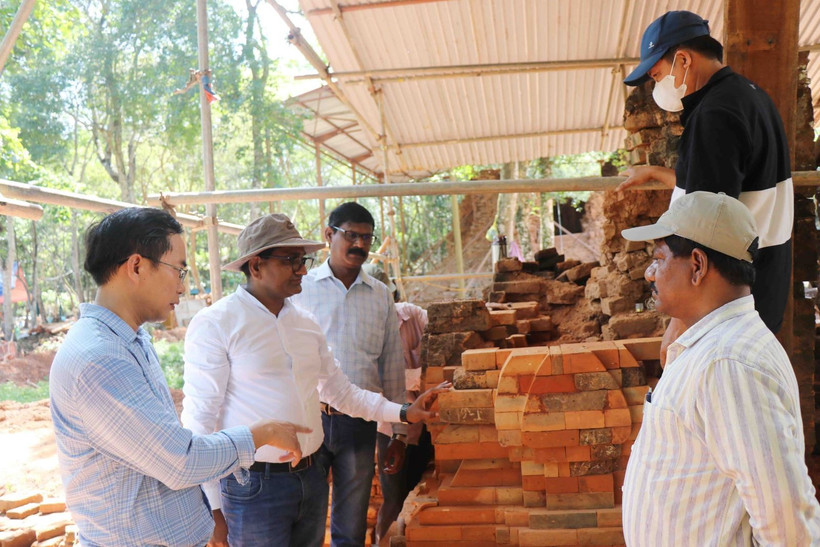
Meanwhile, Tower Groups E and F, consisting of 11 towers, are also undergoing urgent restoration by Vietnamese and Indian specialists. Group E contains eight towers, and Group F comprises three towers.
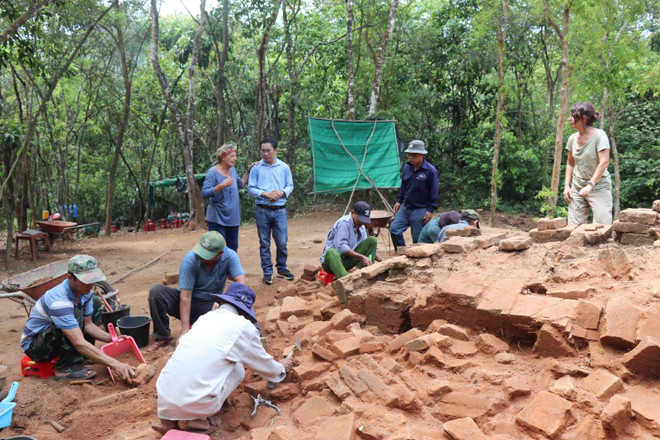
Dr. D.S. Danve of the Archaeological Survey of India, who leads the restoration of Groups E and F, explained that his team is prioritising the urgent restoration of these towers. Early findings from these excavations show that the towers stand on foundations constructed from a combination of brick, timber, and tile.
In general, the tower walls are built with bricks stacked without visible mortar, said Danve, adding that they are applying this traditional construction technique in their restoration process to maintain the original look of these structures.
Nguyen Van Tho, head of the Preservation Department at the My Son World Cultural Heritage Museum, stated that the findings continue to highlight the exceptional value of the complex.
“Recent excavations suggest that these architectural structures were constructed very early,” Tho noted. “The discoveries of artistic sculptures during this excavation also highlight the worship of Shiva, as well as the cultural exchange between the Champa Kingdom and ancient nations in the region.
Due to multiple factors, particularly the passage of time, many elements within the temple complexes have deteriorated and suffered serious damage. Urgent and decisive action in conservation efforts for the tower groups, especially E and F, is of utmost importance.
My Son was recognised as a UNESCO World Heritage Site in 1999 thanks to its historical, artistic and architectural significance.
My Son is a complex of temples and towers belonging to the Cham civilisation, located in Duy Xuyen district, Quang Nam province. Constructed from the 4th to the 14th century, it was once the religious and cultural centre of the Champa Kingdom, closely associated with Hindu beliefs, particularly the worship of Shiva, a major Hindu deity. The complex comprises over 70 architectural structures, but today only about 20 towers remain relatively intact, due to the effects of time and war./.