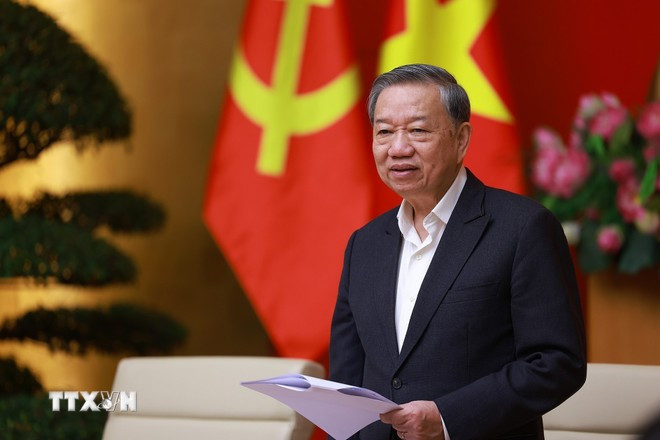
Hanoi (VNA) – Vietnam is expected to enter the group of upper-middle-income nations, with per capita income topping 5,000 USD later this year, Party General Secretary To Lam projected in his article titled “Private Sector Development – A Lever for Prosperous Vietnam” published on March 17.
Lam traced Vietnam’s economic ascent over nearly four decades of reform, transforming itself from a centrally planned, inefficient economy with a meager 96 USD per capita income in 1989 to a middle-income nation after joining the lower-middle-income group in 2009.
By late 2024, Vietnam’s GDP sustained continuous growth for 44 consecutive years, ranking among the fastest-growing economies globally. From 140.5 billion USD in 2010 (0.22% of global GDP), it soared to 362 billion USD in 2021 (3.75%), 430 billion USD in 2023 and 476.3 billion USD in 2024.
Globally, Vietnam’s GDP ranking climbed from 53rd in 2010 to 33rd in 2024, while regionally, it advanced from sixth to fifth in Southeast Asia and from 17th to 14th in Asia.
Lam noted that Vietnam’s growth has outpaced the developing-world average two-fold, defying global economic turbulence. Once aid-dependent, it now ranks 24th worldwide in purchasing power parity, with social gains boosting citizens’ quality of life.
Looking ahead, Vietnam targets modern industrial status with upper-middle-income standing by 2030 and high-income developed status by 2045.
According to experts, achieving the above goals requires sustained growth of at least 8% in 2025 and 10% annually thereafter. To catch up with developed Asian economies, the country must maintain an average annual growth rate of 9% over the next two decades. Vietnam’s historical growth of 5–7% per year, while steady, falls short of propelling the nation out of the middle-income trap. Given Vietnam’s relatively low economic starting point and modest scale, its growth must consistently outpace global and regional averages to close the gaps with its peers.
The 20-year period from now until 2045 may appear lengthy, but experts cautioned that it is fleeting if annual growth lingers below 8%, or even 10%. Transforming a nation of 100 million people from middle-income to high-income status, lifting per capita income from 4,700 to 15,000 USD - a more than threefold increase - demands an extraordinary growth trajectory.
Vietnam’s economy, though advancing, remains modest compared to several ASEAN neighbours. In 2024, Indonesia’s GDP reached 1.47 trillion USD, Thailand’s hit 548.89 billion USD, and Singapore’s stood at 525.22 billion USD. While Vietnam makes strides, other nations also continue to forge ahead.
Lam previously warned: “Other countries will not wait for us, and we cannot say ‘please slow down and wait for us.’ The risk of falling behind and into the middle-income trap is ever-present unless we chart a new course and act decisively”.
One of the "new paths and bold steps" is to foster an environment where the private sector flourishes, viewing it as “a lever for a prosperous Vietnam”.
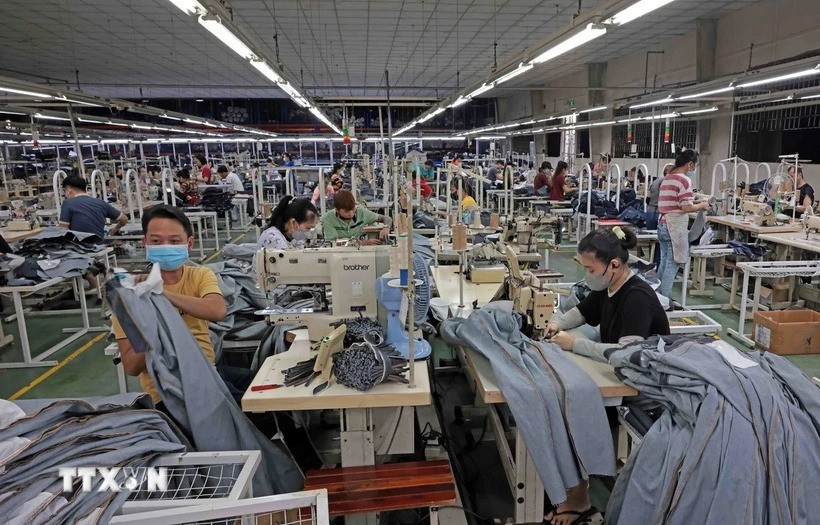
With nearly one million businesses and around 5 million business households, the private sector drives around 51% of GDP, contributes over 30% to the state budget, and generates more than 40 million jobs – over 82% of the country’s workforce, and accounts for nearly 60% of the total social investment capital.
Labour productivity remains a linchpin of Vietnam’s GDP growth, yet it continues to trail the global average by a wide margin. A 2020 Asian Productivity Organisation (APO) report laid bare the gap: Vietnam’s labour productivity lags 60 years behind Japan, 40 years behind Malaysia, and 10 years behind Thailand. In 2022, each Vietnamese worker generated 188 million VND (7,361 USD) annually, equivalent to just 11.4% of Singapore’s output, 35.4% of Malaysia’s, 64.8% of Thailand’s, and 79% of Indonesia’s.
After three consecutive years of falling short, Vietnam’s labour productivity growth defied expectations in 2024, climbing 7.09%. Its overall productivity reached 9,182 USD per worker, a 726 USD hike from 2023.
Private enterprises, a cornerstone of economic growth, still face persistent hurdles in accessing critical resources like credit, land, natural resources, and skilled talent. An inconsistent and overlapping legal framework compounds these challenges, while a business environment bogged down by complex administrative procedures drains time, money, and confidence. Unofficial costs, often tied to weak enforcement or abuse of power by certain officials, further erode property rights and free enterprise, stifling efficiency and deterring investment.
These structural weaknesses, including institutional frameworks, economic policies, and the broader business climate, have bottlenecked the private sector’s growth. Its contribution to GDP has stagnated for over a decade, hampering Vietnam’s ability to boost value-added production, escape the middle-income trap, and fast-track its ambition of becoming a high-income nation by 2045.

To unleash the private sector’s potential, Lam urged swift and sweeping reforms: streamline state governance, overhaul management institutions, simplify administrative processes, empower local authorities through greater decentralisation, and cultivate a pro-business ecosystem.
Specifically, the Vietnamese Government must pivot to a market-oriented regulatory framework that safeguards the private sector’s rights to free enterprise, property ownership, and fair competition. This requires dismantling barriers, improving policy transparency, rooting out vested interests in policymaking and resource allocation, and ensuring equitable treatment across private, state-owned, and foreign-invested firms.
Lam stressed the pressing need for institutional overhaul to forge a “business-friendly, service-oriented administration that serves both enterprises and the nation”. Such a shift requires a radical rethink of governance, including slashing red tape and business regulations with decisive action, while accelerating digitalisation to cut compliance costs and curb unofficial expenses.
Beyond reforms, establishing effective mechanisms for dialogue and policy feedback is critical, enabling the private sector to shape economic decisions with practical, actionable input. Within three years, the leader aims to lift Vietnam’s business climate into ASEAN’s top three./.