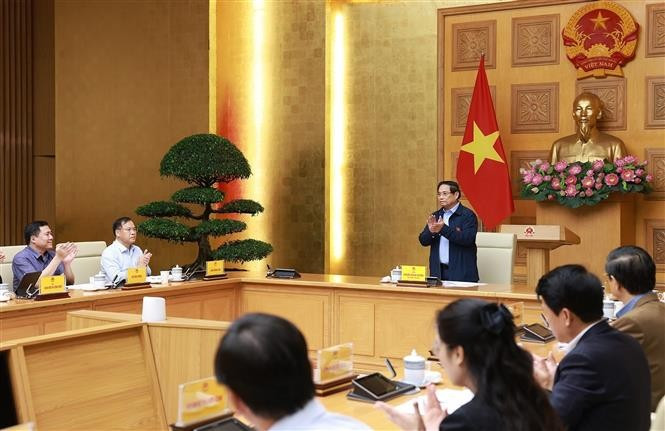
Hanoi (VNA) – Vietnam’s data exchange platform should be built on pioneering regulations, cutting-edge technologies, and a highly skilled workforce as its core drivers, said Prime Minister Pham Minh Chinh.
Chairing a conference on developing a data exchange in Vietnam on November 1, the PM asked for greater efforts to complete the platform in November this year.
He highlighted the importance of developing a data exchange, saying that as Vietnam aims for at least 8% GDP growth in 2025, traditional drivers—investment, exports, and consumption—alone are insufficient, making it essential to leverage new growth engines like the digital economy, especially data.
Recalling Party General Secretary To Lam’s remark that “data has become an important resource and production material,” the PM noted that Vietnam currently possesses a vast amount of data, yet it remains fragmented and underutilised. Therefore, establishing and developing a data exchange is an essential and objective task to unlock and supplement resources for the country’s socio-economic development.
He stressed that a successful data exchange in Vietnam will create a high-value market driving economic growth, help boost competitiveness of the country and businesses, foster a professional international-standard data services market, and spur technology development and innovation.
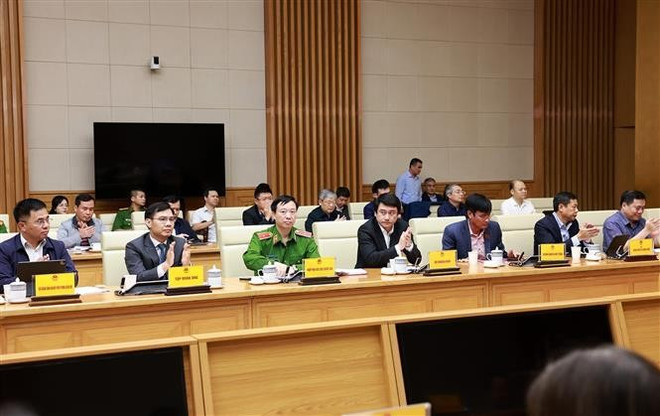
It will also contribute to improving national governance; accelerating the standardisation, transparency, interoperability, and reuse of data across government agencies, as well as between the public and private sectors, while ensuring security, sovereignty, and national standing, ultimately supporting the development of a self-reliant economy and boosting international integration, he added. The Government leader urged ministries, localities, and businesses to adopt innovative thinking and strategic vision in developing a national data exchange, emphasising that this is a new but essential task for the country’s digital transformation and economic growth.
He said the platform must not serve as a mere data warehouse or marketplace for buying and selling information, but as a foundation to share resources and increase the added value of data.
The data exchange must be developed with institutions playing the pioneering role, infrastructure as the foundation, technology application as breakthrough, human resources as the key, and strong results as motivation, the PM stressed, urging all levels of authorities, the business community, and citizens to work with the highest political determination and move forward with both urgency and caution.
He directed relevant ministries to build and implement policies to ensure the platform’s efficient, safe, and transparent operation. It must have a comprehensive legal framework to protect the rights and legitimate interests of participants while maintaining a balance between the State, businesses, and the public.
The PM emphasised simplified administrative procedures, fair competition, and safeguarding of data security, personal information protection, and innovation freedom.
The Ministry of Public Security was tasked with developing a comprehensive, favourable, and transparent legal framework to govern data trading and management, including special mechanisms for public–private partnerships (PPP), data valuation, supervision, and dispute resolution. The ministry will coordinate with relevant agencies to pilot the data exchange before national implementation.
To support the platform’s operations, the Ministry of Science and Technology will design an ordering mechanism to assign sci-tech and innovations tasks to non-business public service units, organisations, enterprises, and start-ups, helping form large-scale strategic data enterprises. Meanwhile, the Ministry of Industry and Trade must ensure sufficient energy supply, and the Ministry of Education and Training must design a plan on training high-quality data professionals.
The Ministry of Finance will allocate adequate funding for developing and upgrading the National Data Centre, while the Vietnam Data Association, along with domestic organisations and enterprises, were asked to actively participate in the data exchange, and strengthen connections with global data businesses, networks, and markets.
PM Chinh acknowledged that building a national data exchange platform is a complex and challenging task, but one that cannot be delayed.
Ministries, agencies, localities and businesses must act with breakthrough thinking, decisive action, and practical results so that people and businesses truly benefit, he affirmed.
At present, advanced economies are rapidly drafting strategies for developing a data-driven economy, with data exchanges serving as key intermediaries connecting providers and users. Global data exchanges are growing strongly, valued at 344 billion USD in 2024 and projected to reach 655 billion USD by 2029. In Vietnam, the data market was estimated at 1.57 billion USD in 2024 and could reach 3.53 billion USD by 2030.
The country’s digital economy is expected to hit around 45 billion USD in 2025, potentially rising to 90–200 billion USD by 2030, highlighting the vast potential of Vietnam’s data market and the crucial role of a data exchange in the national digital economy strategy./.