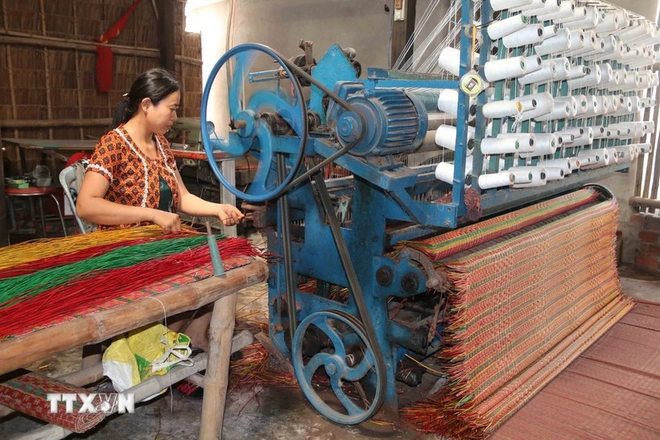
Hanoi (VNA) - From the initial coarse carpets, Ca Hom mats have gradually built a reputation in the market with a diverse range of products, from plain and colored mats to those with floral patterns and printed characters.
Mat weaving in Ca Hom hamlet, Ham Tan commune, Tra Cu district, Tra Vinh province, has a long-standing tradition, primarily in three hamlets: Cho, Ca Hom, and Ben Bạ. Ca Hom is a village with a 95% Khmer population.
According to Decision No. 2321 of the Ministry of Culture, Sports, and Tourism, the mat weaving craft of the Khmer people in Ca Hom has been recognised as a National Intangible Cultural Heritage.
The Department of Culture, Sports, and Tourism of Tra Vinh province stated that the Ca Hom mat weaving village was established in the late 19th century. Initially, mats were produced for personal use, as gifts, or for local consumption. Over time, products from Ca Hom and Ben Bạ gained recognition and became commercialised in the 1940s. Today, these products are highly favored.
Elders recount that the village’s history of mat weaving has experienced many ups and downs. Initially, a few artisans experimented with weaving fabrics using local materials, including reeds for weaving, jute fibers for threads, and bamboo frames as looms. Early mats were basic, mainly plain white, but artisans eventually developed techniques to dye them using natural sources such as turmeric, leading to colored mats.
From coarse mats, the craft evolved into producing colorful and patterned mats. Today, Ca Hom and Ben Bạ mats are known for their quality and variety, including floral and lettered designs.
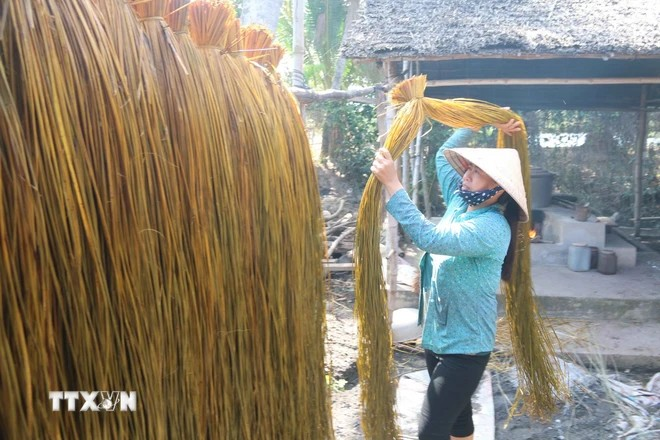
To produce a mat, artisans must follow meticulous steps, starting with selecting mature reeds of suitable length, cleaning and slicing them, and then drying them to precise dimensions. For floral mats, the reeds are dyed by boiling them in a color bath, which requires precise temperature control to ensure vibrant, long-lasting hues.
The floral patterns, especially on two-sided mats, are intricately designed and require great skill. These mats are durable, maintaining their color and quality even after 4–5 years.
In the 1990s, the craft began to disappear due to a lack of raw materials and outdated designs. While many abandoned the trade, Ngo Thi Pho remained committed to her loom, playing a key role in revitalising the craft. Realising that plain mats were losing market appeal, she designed and experimented with floral patterns for two-sided mats. After initial failures, her designs gained popularity in 2000, attracting more customers and orders.
In 2001, with the goal of reviving the craft and providing employment for impoverished Khmer households, the People’s Committee of Ham Tan commune implemented a project to supply looms to 40 households and enlisted Ngo Thi Pho to teach two-sided floral weaving techniques.
Through her dedication, Pho helped restore the Ca Hom-Ben Bạ mat weaving craft, providing a stable livelihood for hundreds of households and creating jobs for many locals.
Today, the Ca Hom-Ben Bạ mat weaving village produces over 150,000 mats annually, supplying markets in provinces and cities nationwide, particularly in the Mekong Delta region./.