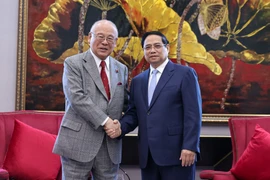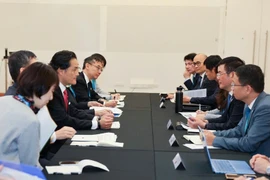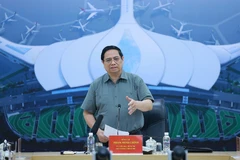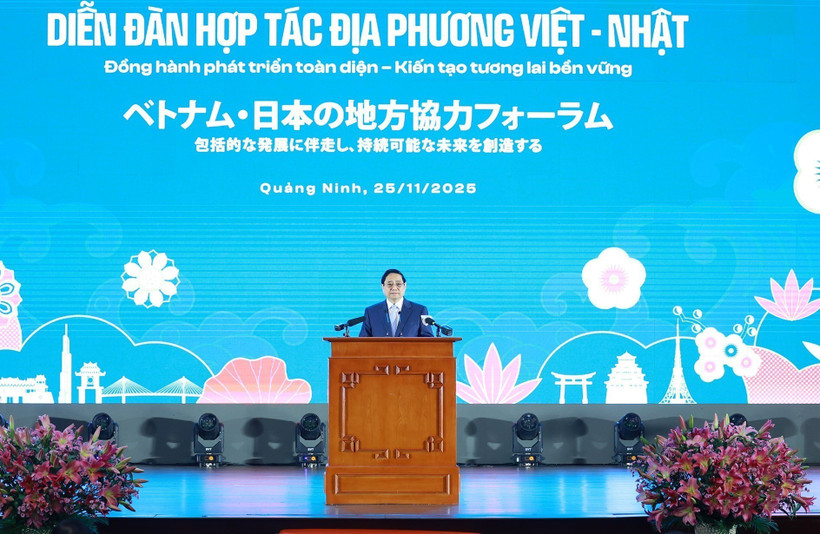
Quang Ninh (VNA) – Prime Minister Pham Minh Chinh on November 25 attended the Vietnam–Japan local cooperation forum held in Quang Ninh province, where he called on Japanese prefectures and enterprises to continue trusting and supporting Vietnam on its development journey, contributing to the prosperity of both nations and their Comprehensive Strategic Partnership.
The event brought together leaders and representatives of nearly 50 localities from both countries, alongside ministries, agencies, businesses and experts. Japanese Prime Minister Sanae Takaichi sent a congratulatory message to the forum.
Since the establishment of diplomatic relations 50 years ago, and especially since the elevation of bilateral ties to a Comprehensive Strategic Partnership in 2023, Vietnam–Japan relations have been thriving. To date, over 110 cooperation agreements have been signed by the two sides’ localities, creating an important foundation for deepening the relations.
The forum aims to materialise the key areas agreed upon by the two countries’ high-ranking leaders, and establish regular dialogue and connectivity mechanisms, helping deepen exchanges, share experience, and advance substantive cooperation that delivers balanced benefits for both sides.
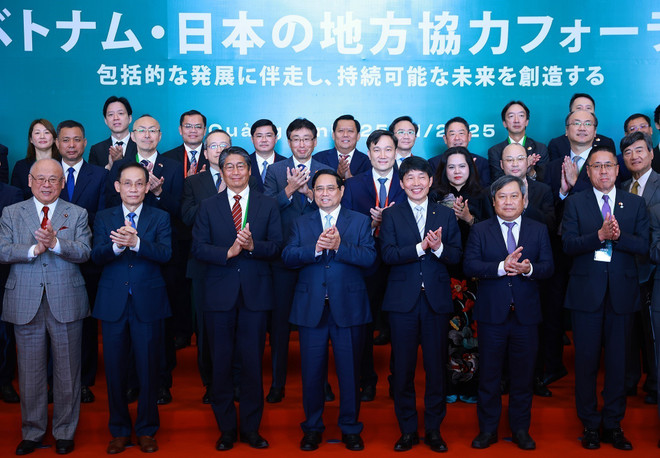
In his remarks, PM Chinh conveyed greetings from Party General Secretary To Lam and extended a warm welcome to all delegates. He stressed that the forum reflects the shared spirit of “unity for strength, cooperation for mutual benefit, and dialogue for trust.”
The PM affirmed that local-to-local and business-to-business cooperation has become a hallmark of Vietnam–Japan relations, serving as a practical channel to translate high-level agreements into concrete agreements and projects. Japan remains one of Vietnam’s most important economic partners, its top provider of ODA and partner in labour cooperation, the third-largest investor, and the fourth-largest trading and tourism partner.
Since the upgrade to the Comprehensive Strategic Partnership, cooperation has expanded to new areas such as digital transformation, green transition, circular economy and creative economy. Innovation and science–technology have emerged as new pillars, opening broader space for joint development.
Briefing delegates on Vietnam’s socio-economic achievements, PM Chinh noted that after nearly 80 years of nation-building and 40 years of Doi Moi (Renewal), Vietnam has transformed itself from a war-ravaged and isolated country into one of the world’s top 35 economies, and among the 20 nations with the largest trade scale. It has signed 17 FTAs with 60 partners and maintained diplomatic ties with 194 countries. Per capita GDP has increased 50-fold; macro-economic stability, social order and national defence-security have been maintained; and people’s living standards have improved.
Stepping into a new development era, Vietnam is committed to addressing bottlenecks in institutions, human resources and infrastructure; mobilising all resources; and accelerating economic restructuring with science-technology, digital transformation and innovation as major drivers. The country aims for double-digit growth from 2026 and strives to become a high-income developed nation by 2045.
Highlighting the vast potential for stronger Vietnam–Japan cooperation, PM Chinh outlined several key directions.
He said localities should proactively leverage their complementary strengths and needs on the basis of mutual benefit. Many Vietnamese provinces seek capital, technology and supporting industries, while many Japanese prefectures face labour shortages, ageing populations and the need for new growth drivers.
The PM emphasised placing enterprises and people at the centre, taking them as the main actors and beneficiaries of cooperation. He urged localities to focus on policies that create favourable conditions for businesses to connect and invest, ensuring that people benefit from “better jobs, higher incomes and better skills.”
Cultural and people-to-people exchanges must remain a long-term foundation, the leader said, encouraging both sides to propose specific initiatives to enhance cultural connectivity, tourism cooperation and mutual understanding between localities.
He held that innovation and digital transformation should be developed as new growth engines, and called for cooperation in digital technology, AI, smart cities, start-up incubation, and R&D centres. He expressed hope that Japan will share experience and support Vietnamese localities and businesses in building innovation ecosystems, digital governance capacity and policies for priority sectors such as AI, mobile infrastructure and semiconductors.
According to the PM, green transition and climate adaptation must be stepped up. He proposed cooperation projects in green infrastructure, urban flood prevention, waste and wastewater treatment, climate-smart agriculture and renewable energy.
The PM welcomed the statement of newly elected Japanese PM Takaichi - “Work! Work! Work! And Work!” - and reaffirmed Vietnam’s readiness to accompany Japanese localities and investors.
PM Chinh called on Japanese localities and enterprises to maintain their confidence in Vietnam and continue deepening cooperation, contributing to shared prosperity and the Comprehensive Strategic Partnership. He expressed his belief that the first Vietnam - Japan local cooperation forum will become an important milestone and a “new catalyst” for future collaboration - aligned with the guiding spirit of sincerity, affection, trust, substance, effectiveness and mutual benefits./.