Vietnam’s two-tier local government model to bring long-term benefits: Chinese scholar

The effective execution of Vietnam’s reforms could not only consolidate its current economic growth trajectory but also serve as a potential governance model for other low- and middle-income countries, and play an important role in the collective development of developing countries, said a Chinese scholar.

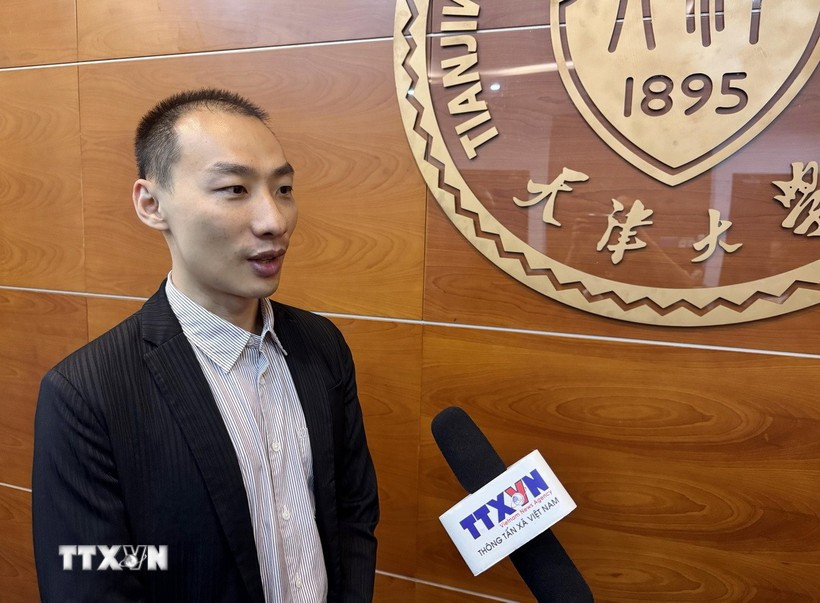
Associate Professor Li Junkai from the Institute for Global South Studies under Tianjin University (Photo: VNA)

Beijing (VNA) – Vietnam’s bold move to merge 63 centrally governed provinces and cities into 34 units and adopt a two-tier local government system will bring about medium-term benefits, according to Associate Professor Li Junkai from the Institute for Global South Studies under Tianjin University.

In an interview with the Vietnam News Agency (VNA) correspondents in Beijing, Li described the reform as a structural overhaul motivated by constitutional amendments.

By eliminating district-level administrations and consolidating provinces, the reform aims to modernise governance and reduce administrative costs. It reallocates financial and human resources to stronger provincial-level governments. Public services previously handled at the district level will now be delivered directly to wards and communes, facilitated by digital government platforms for seamless integration. Li compared Vietnam’s approach to regional reforms with France and China. He held that Vietnam’s complete elimination of district-level governments represents a more thorough restructuring. This reflects strong political determination and a broad national consensus on political reforms.

Assessing the future impact of these changes, he noted that the newly merged provinces and cities will possess greater capabilities and more complete functions. Centralised financial and investment decision-making will enable increased allocation of resources to infrastructure, social welfare, and the digital economy—areas often constrained by redundant administrative structures.

The merger of provinces in northern and central Vietnam will result in unified planning for seaports, railways, and industrial zones. It will also strengthen connections with southwestern China and neighbouring countries in the Indochina Peninsula. From a public service perspective, if the "One Province, One Cloud" digital platform functions effectively, it will facilitate inter-provincial data sharing like for citizen ID, health insurance, and land records, thereby simplifying administrative procedures for citizens.

The Chinese scholar observed that if Vietnam sustains adequate policy support, the country could realise economic efficiencies similar to those of France and China.

Li highlighted Vietnam’s growing momentum in export-oriented manufacturing, the digital economy, and green energy. He argued that if the administrative simplification is effectively implemented, it could reduce institutional transaction costs, create clearer provincial-level investment channels, and foster a more favourable policy environment. This, in turn, could attract investment from both domestic and international partners, particularly those from the Global South, in areas such as renewable energy, smart agriculture, and digital port infrastructure.

He also cautioned that successful reform will require the government to listen to public opinions, balance development opportunities between major cities and local communities, integrate local identity into regional development strategies as France has done, and bridge the urban–rural gap through digital governance tools, as seen in China.

The effective execution of Vietnam’s reforms could not only consolidate its current economic growth trajectory but also serve as a potential governance model for other low- and middle-income countries, and play an important role in the collective development of developing countries, he said./.

VNA
See more

Ministries and sectors are requested to pay special attention to promoting election publicity and legal education. - Illustrative image (baochinhphu.vn)

Government sets out coordinated plan for 2026 elections

The plan also aims to ensure that the elections are conducted in a democratic, equal and law-abiding manner, while being safe and cost-effective, truly becoming a nationwide civic event, thus contributing to strengthening and enhancing the effectiveness and efficiency of the state apparatus and building a socialist rule-of-law state of Vietnam of the people, by the people and for the people.

President Ho Chi Minh’s image featured on ballots at Communist Party of Uruguay congress (Photo: VNA)

Image of President Ho Chi Minh appears on ballots at Uruguay Communist Party congress

Among the ballots used at the congress were three featuring posters of President Ho Chi Minh and one bearing an image depicting the Vietnamese people engaged in production during the period of resistance against foreign aggression. The latter also carried the inscriptions “80th Anniversary of Vietnam’s National Day” and “33rd National Congress of the PCU".

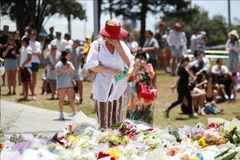
Flowers are laid in memory of victims of the shooting on Bondi Beach in Sydney, Australia, on December 15, 2025. (Photo: Xinhua/VNA)

Vietnam sends sympathy to Australia following Sydney shooting

Prime Minister Pham Minh Chinh on December 15 sent a message of sympathy to his Australian counterpart Anthony Albanese over a shooting that occurred on December 14 at Bondi beach in Sydney, New South Wales, resulting in multiple civilian casualties.

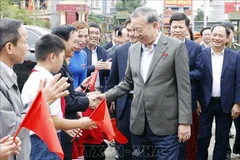
Party General Secretary To Lam and NA deputies are welcomed by locals in Hung Yen on December 15, 2025 (Photo: VNA)

Party leader meets with voters in Hung Yen province

Responding to Hung Yen voters’ recommendations, Party General Secretary To Lam affirmed the consistent principle of placing people at the centre, safeguarding their legitimate rights and interests, and ensuring that all policies and decisions serve the people.

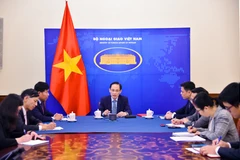
Minister of Foreign Affairs Le Hoai Trung holds phone talks with Philippine Secretary of Foreign Affairs Maria Theresa Lazaro on December 15. (Photo : VNA)

Vietnamese, Philippine foreign ministers hold phone talks

Minister of Foreign Affairs Le Hoai Trung and his Philippine counterpart Maria Theresa Lazaro agreed to continue promoting efforts to elevate bilateral ties to a new height, including stepping up high-level and all-level delegation exchanges across Party, State, National Assembly and people-to-people channels.

The NA Standing Committee's meeting on electoral affairs on December 15. (Photo: quochoi.vn)

NA Standing Committee discusses electoral affairs

The NA Standing Committee adopted a resolution on the first adjustment to the structure, composition, and number of candidates nominated for the 16th NA, and approved a plan to supervise and inspect the election.

National Assembly Chairman Tran Thanh Man chairs the fourth meeting of the National Election Council on December 15, 2025. (Photo: VNA)

Election preparations on track ahead of upcoming polls: NA Chairman

Highlighting key positive aspects of the preparation process so far, the top legislator pointed to the strong, coordinated engagement of agencies from the central to local levels, swift yet methodical progress, particularly in finalising documents, developing organisational plans and drafting resolutions on electoral units.

Frigate 015 – Tran Hung Dao and the delegation of the Vietnam People’s Navy (VPN) on December 14 leave Jinhae Naval Base. (Photo: qdnd.vn)

Frigate 015 – Tran Hung Dao concludes visit to RoK

During the visit, officers and sailors of the two navies toured Frigate 015 and the RoK Navy’s Munmu the Great destroyer, shared experience in training and long-duration deployments at sea, and took part in sports exchanges. The VPN delegation also hosted a banquet aboard Frigate 015 for senior officers and sailors of the host navy.