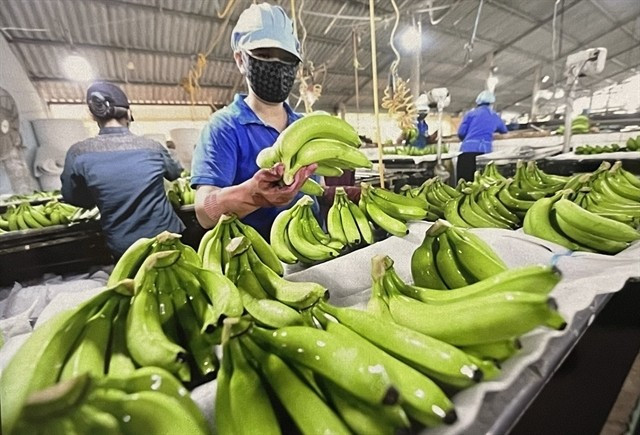
HCM City (VNS/VNA) - Experts and businesses believed that with stronger investment, value-chain-based production and expanded export markets, banana exports could realistically approach the 1 billion USD target.
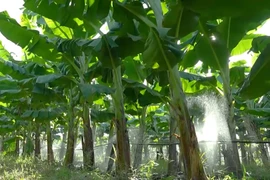
Bananas have been identified as a priority product under the Project for the Development of Key Fruit Crops to 2025, with a vision to 2030, approved in October 2022. Under the plan, banana acreage is projected to reach 165,000–175,000ha by 2030, with output of 2.6–3 million tonnes.
Production will be concentrated in major growing regions such as the Red River Delta, the northern midlands and mountains, the North Central region, the South Central coast, the Central Highlands, the Southeast and the Mekong Delta.
Speaking at a forum organised on December 13 in Ho Chi Minh City to discuss solutions for preventing and controlling Panama disease in bananas, Associate Professor Dr Le Quoc Doanh, former Deputy Minister of Agriculture and Rural Development and Chairman of the Vietnam Gardening Association, said Vietnam currently produces around 2.8 million tonnes of bananas each year. Banana acreage and yields have increased steadily, reflecting growing market demand and the sector’s expanding production capacity.
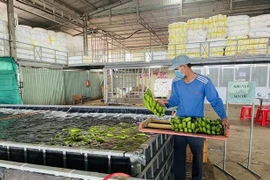
In 2024, banana exports generated about 372–378 million USD, ranking fourth among Vietnam’s fruit exports, after durian, dragon fruit and coconut. However, Doanh noted that this figure remains modest compared to the sector’s production scale and overall potential.
According to Nguyen Quoc Mạnh, Deputy Director of the Department of Crop Production and Plant Protection, total banana-growing area nationwide is expected to reach about 163,000–163,500ha by 2025, with output estimated at 2.75 million tonnes per year.
From a business perspective, Pham Quoc Liem, Chairman of U&I Agriculture Corporation, said the global banana market was valued at about 15.3 billion USD in 2024 and is forecast to reach 21 billion USD by 2030. Although Vietnam ranks ninth worldwide in banana production, export value remains relatively low at around 380 million USD.
He said that Vietnamese bananas hold less than 40% market share in China, about 3% in Japan and under 17% in the Republic of Korea, despite favourable trade agreements and geographic proximity. These figures indicate significant room for growth.
Despite its strong prospects, the sector continues to face significant challenges. Manh said market information remains limited for producers, while prices fluctuate sharply, particularly for shipments that do not meet official export requirements. In addition, increasingly strict technical barriers in importing markets, especially related to plant quarantine and chemical residue limits, are placing greater pressure on both farmers and exporters.
Doanh identified plant disease as the most serious threat to the sector, with Panama disease posing the greatest risk. Caused by Fusarium fungus, the disease persists in the soil, spreads rapidly and can cause severe production losses. He stressed that focusing solely on disease control is insufficient, calling instead for a comprehensive strategy covering plant varieties, cultivation techniques, production organisation and market development.
Providing further scientific insight, Dr Tran Ngoc Hung from the Fruit and Vegetable Research Institute said Panama disease in Vietnam is caused by Fusarium oxysporum f. sp. cubense. The fungus survives for long periods in the soil, enters through plant roots and blocks the vascular system, leading to leaf yellowing, wilting and plant death. Its strong resistance to conventional fungicides makes chemical control largely ineffective.
Globally, Panama disease has severely affected banana production since the mid-20th century and remains a major threat, causing an estimated 1 billion USD in losses each year. In Vietnam, the disease became widespread from 2016–2017, devastating many Cavendish banana-growing areas and forcing farmers to switch to other crops.
To curb its spread, Vietnam has joined international cooperation programmes, including the Asia-Pacific Banana Network, while stepping up research and training.
"The most fundamental and sustainable solution is the development of disease-resistant banana varieties," said Hung.
Under the national seed programme to 2025, with a vision to 2030, priority has been given to breeding high-yield, high-quality varieties resistant to Panama disease. Several varieties have shown strong resistance, including UNI 126 developed by U&I Agriculture Corporation and Furi 5 from the Fruit and Vegetable Research Institute.
Experts at the forum agreed that with effective disease control, sustainable production restructuring and stronger value chains, Vietnam’s banana sector has an opportunity to become a billion-dollar export industry in the near future.
The forum was jointly organised by the Department of Crop Production and Plant Protection, in coordination with the Agriculture and Environment newspaper and the Fruit and Vegetable Research Institute under the Ministry of Agriculture and Environment./.
VNA