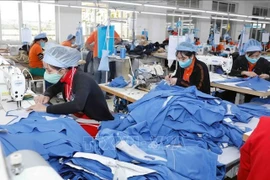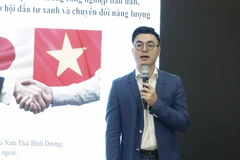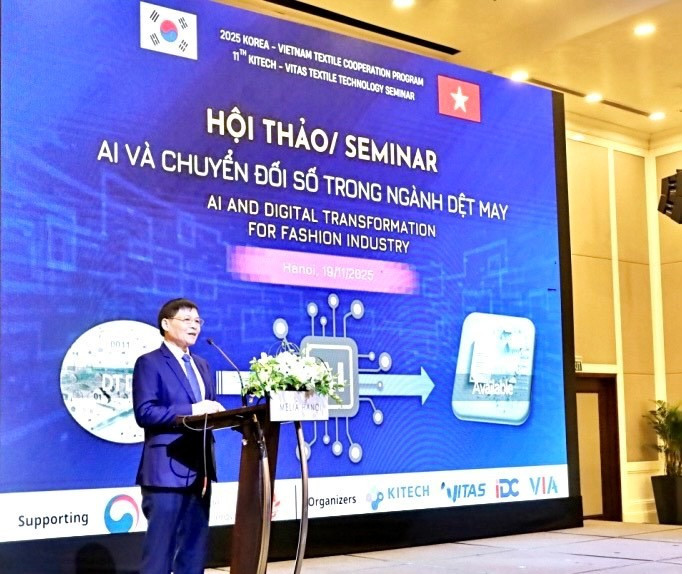
Hanoi (VNA) – The Industrial Development Centre (IDC) under the Ministry of Industry and Trade, in collaboration with the Vietnam Textile and Apparel Association (VITAS) and the Korea Institute of Industrial Technology (KITECH), held an international workshop in Hanoi on November 19, focusing on AI and digital transformation in the textile and garment industry.
IDC Director Chu Viet Cuong underlined that automation is becoming an inevitable trend in the global garment industry. Technologies such as sewing robots, automated cutting systems, AI-powered line balancing and smart production lines are enabling Vietnamese manufacturers to boost productivity, reduce labour dependence, and enhance product quality and consistency.
He added that sustainable fashion supported by AI tools, including 3D design, product lifecycle management, traceability and data-driven production optimisation, is essential for meeting green, circular and low-emission standards.
Vietnam’s textile industry now faces an urgent need to modernise technology, raise productivity and comply with increasingly rigorous environmental requirements amid fast-changing global markets. Access to advanced technologies and modern production models is therefore critical and aligns with Vietnam’s green transition goals and international commitments. IDC, as the ministry’s technical support unit, affirmed it would continue assisting textile enterprises in technological renewal, digital transformation, expert connections and sustainable development.
VITAS Vice Chairman and Secretary-General Truong Van Cam said textile enterprises must now carry out a dual transformation - digitalisation and greening, which has become essential rather than optional. Over the past decades, Vietnam’s economy, including the textile sector, has grown strongly with significant foreign direct investment (FDI), in which the Republic of Korea remains one of the leading investors.
By the end of 2024, total FDI from Korean enterprises in Vietnam is expected to reach around 90 billion USD. In the textile sector alone, Korean investors have contributed nearly 6 billion USD to more than 1,000 active projects, accounting for one-fifth of the sector's total FDI. These enterprises not only operate high-tech projects but also introduce solutions that enhance competitiveness and reduce costs.
Experts noted that while processes such as fabric inspection, cutting and packaging have achieved high levels of automation, sewing continues to lag behind. They outlined a roadmap that includes the use of AI-based vision systems (such as OSHIMA and Morpha AI) for fabric defect detection and KUKA robots for packaging. They emphasised that achieving success relies not only on investing in machinery but also on having a clear strategic direction and adapting hybrid systems to fit each factory's unique conditions.
On sustainability, Cold-Pad-Batch (CPB) dyeing technology is emerging as a key solution for low-emission knit fabric production. This greener method is considered the future of textile dyeing and offers strong economic benefits. Data show that CPB can reduce utility costs for water, steam, electricity and salt by 72.8% and cut emissions by 0.3359 kg of CO₂ per kilogramme of fabric compared with traditional dyeing processes.
Digital transformation and the adoption of AI/3D technologies are also reshaping the fashion industry. Digitalisation is the first essential step in turning data into digital assets, enabling the use of AI and Big Data. Integrating 3D and AI tools from platforms such as Adobe (Substance 3D, GenAI) and CLO Virtual Fashion significantly shortens product development cycles and increases efficiency and sustainability. Adobe technologies can create digital samples four times faster than physical ones, while CLO’s ecosystem with tools like AI Pattern Drafter and Auto Fitting Tool aims to replace up to 90% of physical samples with 3D models.
According to Cam, digital transformation helps enterprises move faster, enhance competitiveness and improve product and process quality. Meanwhile, green transition is a prerequisite for long-term and sustainable development, as is complying with strict global standards. With 85% of Vietnam’s textile output exported, enterprises must meet international requirements on sustainability, labour standards and environmental management across the supply chain.
VITAS expects the workshop to generate practical cooperation opportunities between Vietnamese enterprises and international partners, especially those from the RoK./.
See more
Keeping the Airbus fleet flying: Inside Vietjet’s 32-hour emergency response
When Airbus issued an urgent technical alert at 11:00 p.m. on November 28, Vietjet was thrust into one of the most time-critical operational challenges in its history.
Made in Vietnam Fair set to open in Hanoi
The Made in Vietnam Fair will showcase a wide range of products, including industrial and consumer goods, processed foods, agricultural produce and handicrafts, with the participation of distribution systems, e-commerce platforms, digital platforms and digital financial solution providers operating in Vietnam.
Three airlines to operate inaugural flights to Long Thanh airport on December 19
Three flights operated by Vietnam Airlines, Vietjet Air, and Bamboo Airways will make the first official “inaugural landings” at Long Thanh International Airport in the southern province of Dong Nai on December 19.
2025 a good year for Vietnam’s securities sector: SSC
During the year, the SSC made significant progress in improving the legal and policy framework. Institutional work was implemented in a coordinated manner, including the issuance of two decrees, one resolution, seven circulars and three major schemes. At the same time, the regulator strengthened policy dialogue and expanded cooperation with international organisations to support the market upgrade process.
Vietnam shifting FDI attraction focus from volume to quality
As production relocation to Southeast Asia accelerates and competition for FDI intensifies, Vietnam faces increasing pressure from regional rivals such as India, Malaysia and Indonesia, which are offering bold tax incentives and developing specialised industrial parks. This reality requires Vietnam to shift its focus from attracting large volumes of capital to drawing high-quality investment, prioritising core technologies, innovation, value chain linkages and higher localisation rates.
Reference exchange rate down 3 VND on December 16
The State Bank of Vietnam set the daily reference exchange rate at 25,141 VND/USD on December 16, down 3 VND from the previous day.
Real estate market will have clear divergence next year
Vietnam’s real estate market is currently driven by real demand, transparent legal frameworks, and a more positive foundation thanks to new legal corridors, with expectations of a clear recovery in 2026.
Ho Chi Minh City steps up oversight of unqualified fishing vessels
HCM City currently has 4,475 fishing vessels, all of which have been registered and updated on the VNFishbase system. Among them, 4,268 vessels, or 95.37%, have been granted fishing licences, while 207 unqualified vessels are being strictly managed and kept ashore.
Ample room remains for trade, investment cooperation with Japan, RoK
A seminar was held in Ho Chi Minh City on December 15, aiming to explore ways for fostering Vietnam's trade with the two Northeast Asian countries.
First technical flight lands at Long Thanh International Airport
After landing, the aircraft was greeted with a traditional water salute from two fire tenders to welcome the first aircraft plane to land safely at the new airport.
VinFast inaugurates EV plant in Indonesia
The VinFast Subang plant was completed and put into operation just 17 months after groundbreaking, demonstrating the company's rapid execution capability and strong implementation capacity. This is VinFast's fourth operational facility worldwide, and its first plant in Indonesia and Southeast Asia outside of Vietnam.
Resolution 57: Pilot models spread to boost productivity, quality
From 2021 to 2025, assistance reached more than 6,400 enterprises in adopting productivity and quality enhancement solutions, while 102 pilot models were rolled out, hitting targets five years ahead of schedule.
HanoiTex & HanoiFabric 2025 to open with 250 booths from nine markets
The event will open direct entry to Vietnam’s rapidly expanding textile and garment market, providing a platform to connect with thousands of prospective buyers, promote global brands and forge strategic partnerships across Asia.
Bamboo Airways adds Airbus A320 ahead of peak travel season
The timely addition boosts capacity for the carrier and advances its fleet rebuilding effort since returning to management under FLC Group.
HCM City businesses ramp up production to meet Lunar New Year demand
From early December, major retail chains in the city have recorded a noticeable increase in shoppers seeking Tet products. Many consumers are taking advantage of promotional programmes to purchase gift items with long shelf lives, such as confectionery, soft drinks and processed foods, well ahead of the holiday peak.
Reference exchange rate down 4 VND at week’s beginning
With the current trading band of +/- 5%, the ceiling rate applicable for commercial banks during the day is 26,401 VND/USD, and the floor rate 23,887 VND/USD.
Vietnam to host seminar on export growth strategies
Vietnam's exports rose 16.1% to 430.2 billion USD in the first 11 months of 2025, while total trade hit 839.8 billion USD during the same period. This strong performance shows that exports remain a key driver of economic growth, boosting Vietnam's standing on the world stage in recent years.
PM requests greater efforts to operate Long Thanh International Airport on schedule
Long Thanh International Airport in Dong Nai province has a total investment of over 16 billion USD, divided into three phases. Construction of the first phase, estimated to cost 5.4 billion USD, began in 2020. Once operational, it is expected to handle 25 million passengers and 1.2 million tonnes of cargo each year.
Hai Phong Port reaches 2-million-TEU milestone
Handling the 2 millionth TEU in 2025 not only demonstrates Hai Phong Port’s operational capacity and the collective efforts of its workforce, but also highlights its increasingly important role in regional and global supply chains, the confidence of shipping lines, logistics firms and the business community, and the effectiveness of policies to improve the investment climate and strengthen maritime infrastructure and services.
Tracing origins hindered by fragmented data systems
As the Government accelerates the digital economy, establishing a unified national traceability system has become a crucial move to end data fragmentation and disconnection among ministries, sectors and localities.