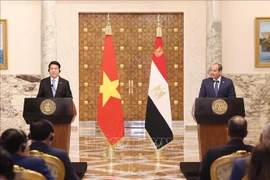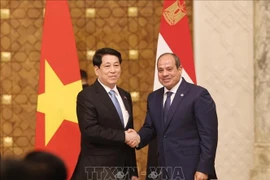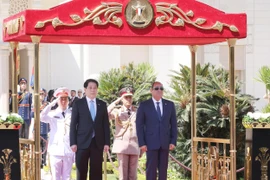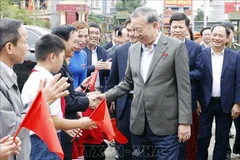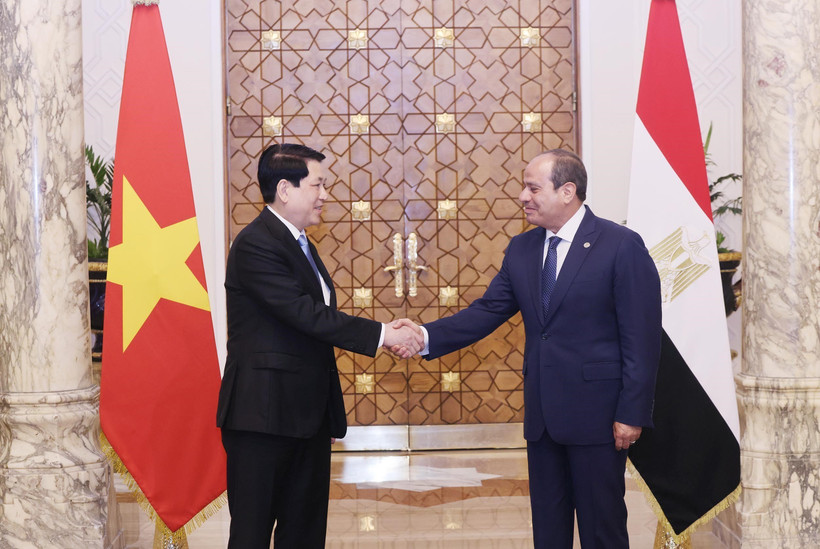
Cairo (VNA) – State President Luong Cuong and Egyptian President Abdel Fattah El‑Sisi issued a Joint statement on the upgrade of Vietnam - Egypt ties to a Comprehensive Partnership, following their tête-à-tête and official talks in Cairo on August 5.
The Vietnam News Agency (VNA) respectfully introduces a translation of the joint statement.
At the invitation of H.E. Abdel Fattah El-Sisi, President of the Arab Republic of Egypt, H.E. Luong Cuong, President of the Socialist Republic of Vietnam, pays a state visit to Egypt from August 3 to 6, 2025. During the visit, the two leaders held talks with in-depth discussions on bilateral cooperation and exchanged views on regional and international issues of mutual concern.
Since the establishment of diplomatic relations in 1963, the traditional friendship between the Socialist Republic of Vietnam and the Arab Republic of Egypt has achieved significant accomplishments and expanded across various fields. This relationship has been consolidated and nurtured on the basis of friendship, equality, mutual respect, and cooperation for the benefit of the people of both countries.
With the desire to further deepen political trust and elevate the bilateral ties between the Socialist Republic of Vietnam and the Arab Republic of Egypt to a more profound and comprehensive level, during President Luong Cuong’s state visit to Egypt, the senior leaders of Vietnam and Egypt agreed to upgrade the bilateral relationship to a Comprehensive Partnership.
The elevation of the bilateral relations to the Comprehensive Partnership reflects the stature of the relationship in the new period, establishing a higher level of political trust across all levels, and broadening the scope and depth of cooperation in a more comprehensive, substantive, and profound manner across all areas. The upgrade also upholds and strengthens new cooperation mechanisms based on respect for international law, and independence, sovereignty, territorial integrity, and political system of each country.
To realise the vision of the Comprehensive Partnership, the two countries agreed to intensify collaboration in the following key areas:
I. COOPERATION IN POLITICS, DIPLOMACY, SECURITY, AND DEFENCE:
The two sides will continue to increase the exchange of delegations and bilateral meetings across all channels and levels, especially at the high level, and in various sectors. In addition, the two countries will promote and increase the effectiveness of existing mechanisms, such as the Joint Committee and Political Consultations, and will explore and promote the establishment of subcommittees for cooperation in specialised areas of mutual interest, including investment and agriculture.
Both sides agreed to strengthen collaboration in the fields of defence, security, law, and justice in line with each country’s needs and capacities; and held that promoting defence and security cooperation will help safeguard independence, sovereignty, and territorial integrity of each country and contribute to maintaining a peaceful and cooperative environment in both regions and in the world. The two sides will also enhance cooperation and share experiences in United Nations peacekeeping operations and in mediation efforts for regional and global conflicts.
Sharing a common view on the importance of maintaining peace, stability, and prosperity in each region and the world at large, the two sides will continue close coordination and mutual support at multilateral forums, including the United Nations, the Association of Southeast Asian Nations (ASEAN), the Arab League (AL), the African Union (AU), and the Non-Aligned Movement (NAM). The two sides will also enhance consultation, share stances, and coordinate efforts in addressing regional and international issues of mutual concern.
II. COOPERATION IN ECONOMY, TRADE, INVESTMENT, AND AGRICULTURE:
Both sides identified cooperation in trade, investment, and agriculture as key pillars of the bilateral relationship in the new phase, based on the principles of equality, balance, and mutual benefit, contributing to the realisation of each country’s socio-economic development goals.
The two sides welcomed the promotion of studies towards launching negotiations on a feasible bilateral trade and economic agreement. They committed to increasing trade promotion activities and creating maximum conditions to boost the exchange of goods, including opening markets for certain export products of each other. Both sides agreed to cooperate in establishing appropriate mechanisms to reduce the trade imbalance between the two countries and to enhance cooperation between their respective commercial banks.
The two sides agreed to prioritise stepping up investment cooperation and create favourable conditions for businesses from both countries to connect and enhance investment collaboration; encourage them to engage in bilateral exchanges and seek investment opportunities in each country's priority sectors such as infrastructure, innovation, information technology, digital transformation, and energy transition, and step up trade promotion delegation exchanges. The two countries also agreed to expand the list of priority goods and sectors, including aquatic products, textiles and garments, electric equipment, fertilisers, food, including Halal-certified products, chemicals, pharmaceuticals, cosmetics, new and renewable energy, electric vehicles, logistics, tourism investment, agricultural investment, industrial zones, and economic zones.
Both sides agreed to boost bilateral cooperation in the agricultural sector; enhance the sharing of development experiences and agricultural techniques, particularly in aquaculture, rice cultivation, animal and plant quarantine, and sustainable agricultural development. They reached consensus on the establishment of a coordination mechanism between the two countries' agricultural quarantine authorities to facilitate trade and market access for agricultural products, and to collaborate on safety control procedures for aquatic products traded between the two sides.
Both sides agreed to establish a Vietnam – Egypt Business Council to enhance trade and investment cooperation. The Council will consist of leading companies operating in the sectors of mutual interest.
The two sides agreed to regularly exchange lists of specialised and international trade fairs and exhibitions held in each country and to encourage their respective business communities to participate in.
The two sides agreed to exchange experiences in digitising business registration processes, with the goal of minimising the time required for electronic business registration.
The two sides agreed to share best practices in trade promotion and in expanding investment opportunities for micro-, small-, and medium-sized enterprises (MSMEs), including support for these businesses to take part in international trade fairs and forums.
III. COOPERATION IN SCIENCE, TECHNOLOGY, AND INNOVATION:
The two sides agreed to promote cooperation in the fields of science and technology, digital transformation, and innovation, and to create favourable conditions for businesses from both countries to connect, exchange, and collaborate in these areas.
IV. COOPERATION IN SOCIO-CULTURE, LABOUR, EDUCATION, AND PEOPLE-TO-PEOPLE EXCHANGES:
The two sides agreed to enhance people-to-people exchanges and local-to-local connections, effectively implement the signed Memoranda of Understanding in local development, and other cooperation agreements between cities, step up cooperation in tourism, tourism promotion activities, and the attraction of visitors from each country. In addition, the two sides will share experiences in tourism management and development, particularly in sustainable tourism; and facilitate visa issuance for citizens to encourage tourism, people-to-people exchanges, and cultural collaboration.
The two sides reached consensus on enhancing cultural exchange activities and organising cultural promotion events of each country in the other nation; and strengthen cooperation in education, increase the number of scholarships, and expand training programmes in areas of strength for students of each side./.
VNA