Hanoi (VNA) - From July 1, Vietnam officially commences the operation of a restructured administrative framework, consolidating its provincial-level units from 63 to 34. This monumental “reordering of the nation’s landscape” has received broad public endorsement across all social strata, a favourable foundation for its anticipated success.
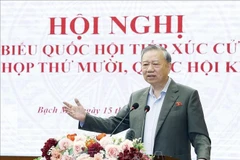
Party General Secretary To Lam wrote in his June 29 article “The Power of Solidarity” that “Without the people's support, even the easiest task will not succeed; with the people's will, impossible tasks can be accomplished.” With public consensus, and the people and leaders sharing purposes, no external force can subdue the nation.
Public confidence rooted in merits of change
Communication activities by all-level Party committees and authorities over the past time aimed to affirm that the policy to reorganise administrative units and establish a two-tier local government model represents a major, strategic reform revolution initiated by the Party Central Committee.
In this endeavour, the Party’s will has become closely intertwined with the people’s aspirations.
At its core, this policy aims to expand development space for provinces and cities, enhance the leadership role of key economic regions, corridors and growth poles; and prioritise the integration of mountainous and lowland areas with coastal regions. This strategy promotes the harmonious, rational grouping of neighbouring localities, aligned with development orientations to facilitate mutual support and drive socio-economic progress, while advancing the nation’s goal of rapid, sustainable development in a new era.
In practice, after nearly 40 years of “Doi Moi (Renewal), the spatial organisation of national development has begun to reveal limitations. Development areas are fragmented along administrative boundaries; regional linkages remain weak; and investment efforts are spread thin rather than concentrated, thus failing to form strong, leading economic zones capable of driving national growth. Additionally, the country still lacks a coherent and modern national infrastructure framework.
These issues primarily stem from dispersed development thinking, a lack of focused priorities, and the absence of a comprehensive national spatial development strategy. Moreover, mechanisms and policies to promote inter-sectoral and inter-regional economic development remain inadequate, while localism still persists in some quarters.
The task of “reordering the nation’s landscape” is no simple matter – in both nature and scale. To achieve success, national unity and consensus are essential.
People will support such reforms if they understand that this is a necessary and inevitable move to redefine the natural and economic development space, reconnecting historical, cultural, and geographical bonds to form a sufficiently large administrative-economic entity. This new structure will enable broader development, coupled with innovations in governance capacity, increased competitiveness, and integration into national and global value chains.
Initial success has been achieved as people now understand that the overhaul will save public expenditure, foster more balanced development, and enable the formation of new economic hubs. The ultimate goal is to develop digital government, smart smart cities, integrated economic zones, and flexible administrative models that offer faster, more transparent public services, saving time and costs for both citizens and businesses. The guiding principle is that the people and enterprises must be better served.
This restructuring effort is also seen as a strategic step toward organising the national development space more effectively – strengthening intra- and inter-regional links, and capitalising on each region’s comparative advantages. Initial investments are to be focused on key localities with favourable geography, infrastructure, skilled labour, and development potential, forming economic corridors and growth poles. These will generate a spillover effect, accelerating national economic development in an efficient and sustainable manner. At the same time, appropriate mechanisms, policies, and resources will be put in place to ensure social welfare in disadvantaged areas, gradually reducing regional disparities.
Moreover, merging provincial-level administrative units would result in the more efficient and economical use of national resources, especially land, water, forests, and minerals.
Putting national interests above sentiment for home province
The recent communication and education efforts have resonated deeply with the public, winning their support and encourgaing them to voluntarily put aside affection for their hometowns to prioritise love for the greater nation. There is growing awareness that decisions regarding mergers, locations of provincial headquarters, and names of new provinces are the result of thorough deliberation by central authorities, with development sustainability, geography, culture, and history taken into account.
A notable example is the merger of Thai Binh and Hung Yen into the new Hung Yen province, with its administrative seat located in the former Hung Yen. This is not a matter of dominance, but rather a case of joining forces for shared development.
The new Hung Yen province now spans over 2,500 square kilometres, twice the size of the former Hung Yen, and is home to more than 3 million people, comprising 1.2 million from the original Hung Yen and 1.8 million from Thai Binh. This consolidation creates a significantly expanded domestic market, enhancing scale advantages for production and services. The removal of administrative boundaries between the two provinces facilitates the movement of capital, labour, and technology, thereby optimising the combined resources.
Meanwhile, the fact that 11 provincial-level administrative units are not included in any merger does not indicate favouritism, but rather reflects specific considerations around population, land area, geography, economy, history, and culture.
For instance, Nghe An and Thanh Hoa provinces in the north-central region possess exceptional internal strengths and diverse terrains, including mountains, plains, coastlines, border crossings, airports, seaports, and expressways. These assets make them self-sufficient growth centres - “microcosms of Vietnam” - capable of driving regional development independently.
The naming of the newly formed administrative units has also received careful consideration in terms of cultural continuity and public convenience. In most cases, one of the original provincial names has been retained to minimise disruptions, especially regarding official documents, geographical identifiers, and business operations.
Naturally, there is an emotional element to “losing one’s provincial name” – this is a human response. But from a national perspective, the supreme interest of the country outweighs local sentiment.
Today, most citizens no longer dwell heavily on concerns like “losing our provincial name,” “having no more districts,” or “our commune being merged out of existence.”
Emphasising the critical importance of unity at this pivotal moment, General Secretary Lam made a call upon the nation: In the current period, as the whole nation is vigorously pursuing the policy of streamlining the organisational apparatus of the political system, merging administrative units, and essentially “reordering the nation’s landscape” to ensure sustainable development, the spirit of solidarity must be harnessed more powerfully than ever.
"With the Party’s strategic vision and leadership mettle, we are determined to uphold and promote the strength of great national unity, viewing it as a “lifeblood” and a “lodestar” running through all undertakings, ensuring that every policy and orientation of the Party and State is thoroughly, consistently and effectively implemented, in full service of the people’s legitimate aspirations./.