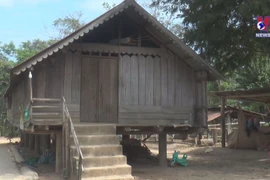
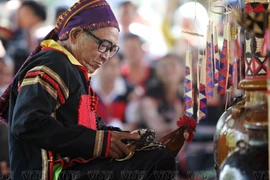
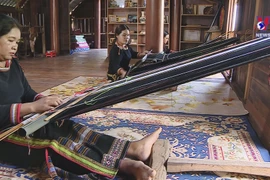
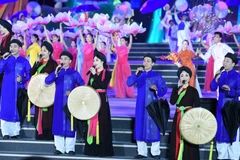
Traditional attire of the Ede ethnic people. (Photo: VNA)
Hanoi (VNA) - The woven fabric of the Ede people is a distinctive artistic product that showcases creativity and intricate artistry. Each piece is not just an ordinary cloth; it encapsulates the ethnic community’s soul and spirit.
The Ede ranks 12th among the 54 Vietnamese ethnic groups in terms of population. It is estimated that over 331,000 Ede people reside mainly in Dak Lak province and the southern part of Gia Lai province in the Central Highlands region, and the western parts of Khanh Hoa and Phu Yen provinces in the south-central region.
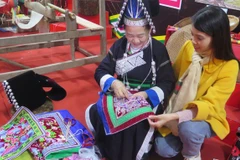
The community possesses a unique cultural identity rooted in a matriarchal system. Similar to those in other ethnic groups, Ede women weave their own traditional fabric, creating blankets, slings, dresses, and daily clothing. They also use it as a dowry in weddings, gifts on special occasions, and even belongings for the deceased.
Distinctive artistry
The raw material for Ede weaving is cotton (known as "Blang" in their language). After harvesting, cotton is beaten, spun into fibers, and then dyed using mud, leaves, roots, or tree bark. Once the desired colored threads are obtained, they are woven onto a frame, forming intricate patterns.
In the past, Ede woven fabric predominantly featured black and red colours. Today, the color palette consists of five basic ones: Hrah (red), Yadu (black), Cakni (yellow), Apiek (green), and Ko (white), occasionally including a rare shade of green.
Ede's black is considered one of the most attractive and durable black hues. The red colour is obtained from the bark of the krung tree, which is ground and cooked to produce a dye. It is not a bright red, but rather a deeper shade reminiscent of fired clay. Red woven products are esteemed and often used for decorative purposes during festivals and ceremonies rather than being cut into household items. The yellow dye, meanwhile, is derived from turmeric.
Depending on the attire, different patterns and arrangements are used. Male clothing differs from female one, and everyday clothing varies from ceremonial attire. The patterns on clothing also transmit the wearer's wealth and authority.
The background of Ede's woven fabric is typically black or dark indigo, lacking the vividness seen in fabrics of northern ethnic groups or the Ede’s neighbour Mnong people. Researchers suggest that the background helps the group to blend with nature, such as fields and forests, where they live.
Traditional craft preservation and development
To weave a piece of fabric, Ede women dedicate a long period of around four months or even more depending on the size and patterns of the cloth. Their weaving serves not only their family's clothing needs but also provides gifts for their relatives. Beautiful and unique pieces can be exchanged for valuable items like pigs, and sometimes even buffaloes and cows.
Today, the traditional craft of weaving is gradually fading away. The number of Ede artisans and women, who know how to weave, is declining due to cultural blending and modern trends. Young people are no longer deeply attached to their traditional culture.
Given such a situation, both the central and local authorities have made efforts to preserve and promote the cultural value of Ede's traditional weaving through the launch of numerous programmes and projects.
Accordingly, Dak Lak has established cooperative models for commercial Ede fabric production to enhance income for the people and pass down the craft to the younger generation.
Recently, the Ministry of Culture, Sports and Tourism has developed plans to organise training courses and workshops for Ede people in Phu Yen province. These courses are expected to guide practical conservation efforts and promote intangible cultural heritage of the community serving tourism development./.